


Agentic AI and the Future of Enterprise IT
From Automation to Agentic AI, enterprises are rewriting the rules of IT
Download the report
Enterprise AI is at a pivotal moment. After several years of accelerating investment in automation and generative AI, organizations are now moving decisively toward Agentic AI: systems designed not just to process information, but to reason, adapt, and collaborate as part of operational workflows.
This evolution signals a strategic shift in how enterprises create value. No longer confined to efficiency gains or cost reduction, AI is beginning to reshape the role of IT itself – from a necessary operational function to a profit-driving, strategic capability.
Digitate’s latest research, based on responses from 600 IT decision-makers across large North American enterprises and building on our 2023 U.S. and 2024 European studies, reveals:
- High trust and confidence in AI across enterprise
- Measurable financial impact from AI adoption
- Regional differences in AI deployment strategies
- Complex dynamics shaping strategies and execution
- The rise of Agentic AI as a true collaborative partner

Key Findings From Today’s Enterprise AI Landscape
Enterprises are moving from experimentation to meaningful outcomes. The latest research shows strong confidence, measurable ROI, and accelerating adoption across large IT organizations. Ninety four percent of leaders consider AI trustworthy. Enterprises report a median return of 175 million dollars. More than half say they already view Agentic AI as an intelligent collaborator inside their workflows. Nearly half report that their IT functions are already semi to fully autonomous. These signals show that AI has crossed a threshold in maturity and is now a defining force in how modern IT organizations operate.

From Automation to Agentic AI
Enterprise AI is entering a new stage. Traditional automation focused on predefined tasks and scripted workflows. Agentic AI moves beyond execution to interpretation and decision making. These systems can understand context, adapt to changing conditions, collaborate with teams, and take meaningful action inside complex operational environments. This transition represents a major shift in how technology supports IT teams. Instead of simply accelerating tasks, AI becomes an active partner that helps manage scale, reduce noise, and increase resilience.
Why IT Operations Lead the AI Revolution
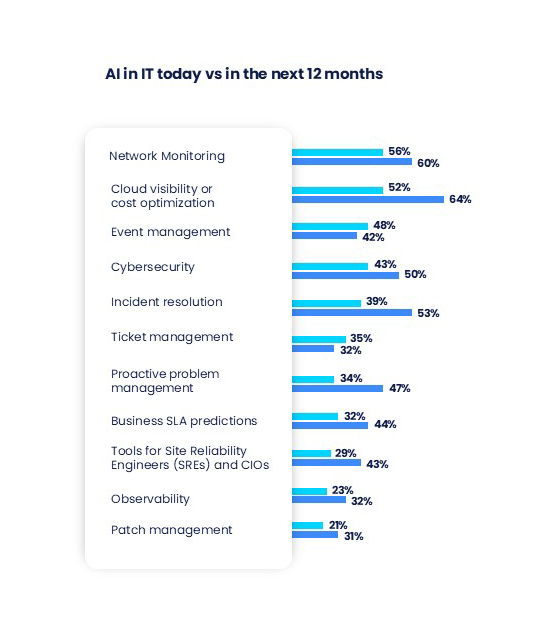
IT has become the primary proving ground for enterprise AI. Seventy eight percent of organizations have already introduced AI into IT operations, and two thirds say IT is where they see the greatest measurable benefit. The highest impact areas include event management, cloud visibility, and early detection of performance issues. These functions generate massive volumes of data and require fast, accurate decision making, which makes them ideal candidates for AI driven augmentation. As complexity grows across hybrid and multicloud environments, AI has become a strategic tool for keeping systems reliable and scalable.

What Agentic AI Can Do for the Enterprise
Agentic AI is designed to operate as a true collaborator inside IT workflows. These systems can interpret signals from across the technology stack, reason through conditions, recommend or take action, escalate issues when needed, and learn from outcomes to improve over time. Enterprises expect Agentic AI to support decision making, enrich team collaboration, and manage repetitive tasks with greater speed and accuracy. The result is a more adaptive and resilient operational environment where AI handles complexity and teams stay focused on higher-value work.

Where Enterprises Are Struggling With AI Adoption
Although AI adoption is rising quickly, organizations still face several challenges as they scale. Teams report high maintenance demands, growing skill gaps, rising costs, and tool fragmentation that slows implementation. Many solutions require specialized expertise or complex integrations that make adoption harder than expected. These barriers highlight the need for AI systems that are easier to manage, faster to deploy, and capable of delivering reliable outcomes without adding operational overhead.
The Path Toward Autonomous IT
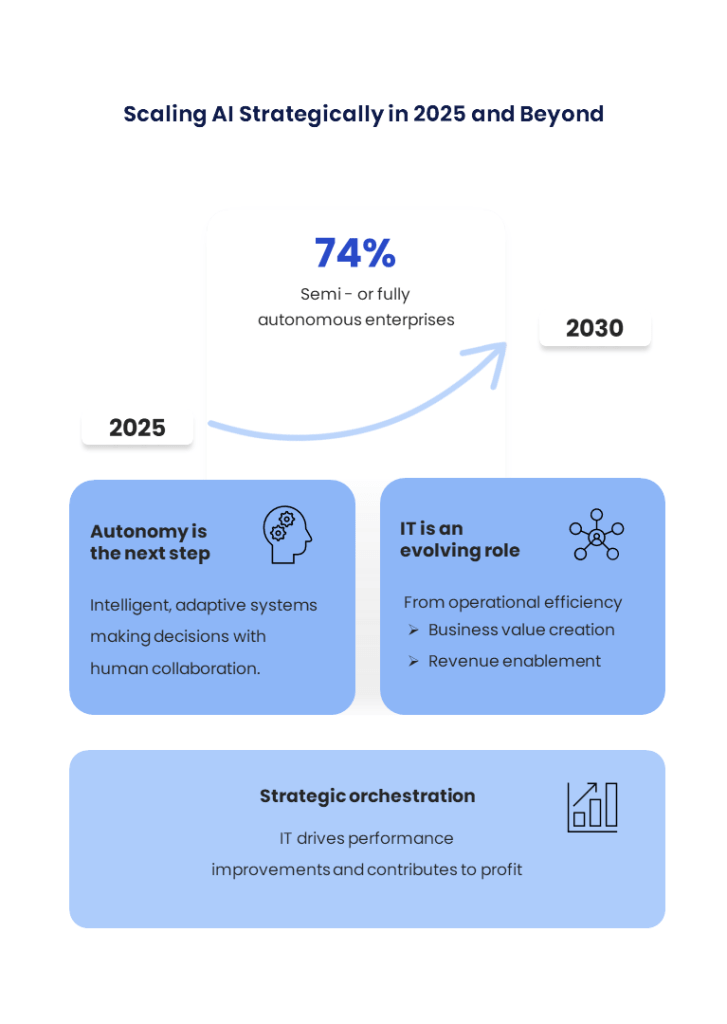
Enterprises are preparing for a future where IT functions operate with increasing levels of autonomy. Seventy-four percent expect their organizations to reach semi or fully autonomous operations in the coming years. Autonomy promises faster decision making, improved resilience, and the ability to manage complexity without scaling headcount. As AI capabilities mature, IT is shifting from manual oversight to strategic orchestration, where teams focus on innovation while AI handles routine and reactive work.

