Skip to content
Business Observability – Bridging the business and IT worldsREGISTER NOW
Reimagining IT Operations: The Role of AI Agents in Modern IT Teams WATCH NOW
ignioâ„¢ release - Digitate Unveils Industry's Most Comprehensive AI AgentsREAD MORE
Enterprise AI & Automation Software Solutions - Digitate
Main Menu
  • Products
      What we solve

      Digitate’s empowers organizations to transform their operations with intelligence, insights, and actions.​

      Platform Overview
      ignio Products

      AIOps

      Redefining IT operations with AI and automation

      • Observe
      • Cloud Visibility and Cost Optimization
      • Business Health Monitoring
      • IT Event Management

      Workload Management

      Enabling predictable, agile and silent batch operations in a closed-loop solution

      • Business SLA Prediction

      ERPOps

      End-to-end automation for incidents and service requests in SAP

      • IDoc Management for SAP

      Digital Workspace

      Autonomously detect, triage and remediate endpoint issues

      Cognitive Procurement

      AI-based analytics to improve Procure-to-Pay effectiveness

      Assurance

      Transform software testing and speed up software release cycles

  • Platform
      What we do

      Digitate helps enterprises improve the resilience and agility of their IT and business operations with our SaaS–based platform.

      Platform Overview
      Platform

      ignioâ„¢ Platform

      ignio™, Digitate’s SaaS-based platform for autonomous operations, combines observability and AIOps capabilities to solve operational challenges

      AI Agents

      ignio’s AI agents, with their ability to perceive, reason, act, and learn deliver measurable business value and transform IT operations.​

      • AI Agent for IT Event Management
      • AI Agent for Incident Resolution
      • AI Agent for Cloud Cost Optimization
      • AI Agent for Proactive Problem Management
      • AI Agent for Business SLA Predictions
  • Resources
      Looking for something?

      Discover how we empower customer success and explore our latest eBooks, white papers, blogs, and more.

      Blogs
      Podcasts
      Customers Success
      Omdia Research Report
      Resources

      Analyst Reports

      Discover what top industry analysts have to say about Digitate​

      ROI

      Get insights from the Forrester Total Economic Impactâ„¢ study on Digitate ignio

      Webinars & Events

      Explore our upcoming and recorded webinars & events

      Infographics

      Discover the capabilities of ignio™’s AI solutions

      Blogs

      Explore insights on intelligent automation from Digitate experts

      Trust Center

      Digitate policies on security, privacy, and licensing

      e-Books

      Digitate ignioâ„¢ eBooks provide insights into intelligent automation

      Podcasts

      Explore our upcoming and recorded podcast

      Case Studies

      Learn how businesses overcame key AI-driven automation issues

      Reference Guides

      Guides cover AIOps and SAP automation examples, use cases, criteria

      White Papers and POV

      A library of in-depth insights and actionable strategies

  • Company

      What we solve

      At Digitate, we’re committed to helping enterprise companies, realize autonomous operations.

      Integration
      Channel Partner
      Technology Partner
      Azure Marketplace
      Resources

      Leadership

      We’re committed to helping enterprise companies realize autonomous operations

      Academy

      Evolve your skills and get certified

      Newsroom

      Explore the latest news and information about Digitate

      Contact Us

      Get in touch or request a demo

      Partners

      Grow your business with our Elevate Partner Program

Request a Demo
Request a Demo
Enterprise AI & Automation Software Solutions - Digitate
BLOG

Statistical Significance Tests: A Statistical Way To Compare Data Populations

By Uday Chandra Bhookya
🕒 8 min read
Table of Contents
Recent Blogs

IT as the Proving Ground for AI: Driving Enterprise Innovation

January 29, 2026

CloudOps Revolution: Redefining SaaS Operations

January 20, 2026

Accelerating IT Transformation with Agentic AI

December 15, 2025

AI Agent for Business SLA Predictions: Safeguarding Business Continuity with Predictive Intelligence

December 1, 2025

AI Agent for Proactive Problem Management: A Shift Toward a Ticketless Future

November 3, 2025

AI Agent for Cloud Cost Optimization: From Blind Spots to Smarter Spend

October 23, 2025

We often come across the need to compare samples of two data sets to derive some conclusions about their similarity. Some common examples include assessing similarity of groups of users based on their purchase history, assessing similarity of servers based on resource utilization, or assessing similarity of applications based on their usage behaviour, among others.  

But how does one measure similarity? Let’s find out! 

To present the concepts, we will compare three pairs of data sets. These pairs are created such that one pair is very similar, another pair is partially similar, and the third pair is very dissimilar. Through these three pairs, you will see how to measure the similarity of such sets. 

Data summary stats

One of the most common ways to measure similarity of two sets is to compare their data summary via mean and median. Figure 1 shows two graphs that compare the means and medians of the three pairs of data sets respectively. As we know, the three pairs have different levels of similarity but that is not exactly reflected in their mean or median values. Here, the data spread around their mean and median seems very similar. Using these graphs, you cannot separate the mean and median of the very similar pairs from the dissimilar pairs. By just looking at the graphs, you would observe that all the three pairs are very similar, but you know that is not the case! Thus, only measuring the similarity based on mean and/or median can be deceptive. 

Mean and median of data sets

Figure 1: Mean and median of data sets. 

Visualization tools

Another commonly used method to measure data similarity is using various visualization tools such as box plots, histograms, and cumulative distribution functions (CDFs). 


  • Box plots provide a graphical representation of the data by rendering minimum, first quartile, median, third quartile and maximum values. Figures 2 compares the box plot of the three pairs of data sets. Unlike the mean or median, the box plots provide a much more informed view of the data dissimilarities.  
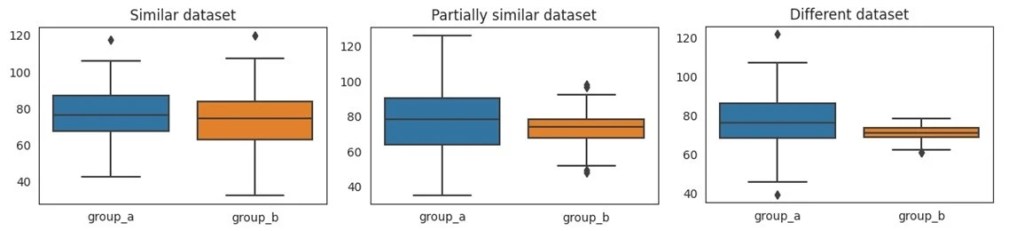
Box plots of data sets

Figure 2: Box plots of data sets 

  • Histograms are another way to provide graphical representation of data. Figure 3 shows the histogram plots of the three pairs of data in our example. Here, the x– axis represents bins of logical ranges or bins of data. The y-axis represents the count of occurrences present in the data for each bin.  
Histograms of data sets

Figure 3: Histograms of data sets 

  • A cumulative distribution plot presents a graphical representation to understand how the values in the group are distributed. Figure 4 shows the cumulative distribution plots of the three pairs. Here, the x-axis shows the values of the variable. For each value on the x-axis, the corresponding value on the y-axis shows the proportion of variable values that are less than or equal to x.
Cumulative distribution plot of data sets

Figure 4: Cumulative distribution plot of data sets. 

Statistical significance tests

While visualization tools are a very expressive way to understand the data, they seldom can be scaled to large data sets. Given hundreds of data sets, comparing them by visualizing charts is an impractical approach. Hence, there is an imperative need to have some mathematical formulations to measure the similarity of data sets. Also, note that in many scenarios the data of the entire population is either unknown or difficult to obtain. In such cases, one needs to work with a sample of the population. This is where statistical significance tests can help. 

Student’s t-test

One of the popular statistical significance tests is the Student’s t-test. An independent two-sample t-test is used to compare the means of two independent groups. The t-value is computed as follows: 

Formula

This equation looks complicated, but it has a very simple explanation. It captures the signal to noise ratio. The numerator represents the signal, i.e., the difference in mean of two sets. The denominator represents the noise, i.e., total variance of the two groups. In other words, the denominator represents how scattered the data population is to trust the difference in the means. Heavily scattered data population indicates high noise. A high t-value indicates high signal and low noise. Similarly, a t-value closer to 0 indicates that the data sets are very similar without having a significant difference.  

The t-value is often computed on a sample of the actual population. When you compute the t-value on another random sample of the same population, the t-value is likely to be a bit different. If you compute the t-value on thousands of such samples, you will end up with thousands of such t-values. Now, the question arises about which t-value to use and how large should the t-value of any random sample be to trust that the two populations are different. This is where p-value comes to help.  

For a given pair of data-samples, Student’s t-test computes the t-value and a p-value. The t-value assesses the difference in the mean of two samples. The p-value provides the probability of getting a t-value at extreme ends in any random sample. In other words, t-value measures how different two samples are by measuring signal to noise ratio. The p-value measures how often we could observe such a signal to noise ratio.  

Figure 5 compares the t-value and p-value of the three pairs of the data sets. 


Similar Groups 

Partially Similar Groups 

Different Groups 

t-value 

1.60 

1.91 

4.00 

p-value 

0.10 

0.06 

0.00008 

Figure 5: The t-value and p-value for three pairs of data sets. 

Different types of t-test

There are different variations of the Student’s t-test. For simplicity, we limited the discussion above to the independent two-sample t-test. Here are three different variations of this test: 

  • Paired sample t-test: This test is used when the two sets are coming from the same population, e.g., compare the CPU utilization of Windows servers before and after a patch upgrade. 
  • Independent two-sample t-test: This test is used when the two sets are coming from two different population, e.g., compare the CPU utilization of Linux and Windows servers. 
  • One-sample t-test: This test is used when a set is compared against some standard value, e.g., compare the CPU utilization of Window servers with the standard acceptable limit of 80% 

The example presented in Figure 5 refers to the independent two-sample t-test. This test works under the assumption that there is no relationship between the two groups, the data in each group is approximately normally distributed and the two groups are obtained via random sampling from the population. 

Hypothesis testing

Statistical significance tests belong to the wider class of tests called hypothesis testing. Hypothesis testing is a statistical method used to determine if a certain hypothesis is true or not based on the available sample data.  

  • First, state your null and alternate hypotheses. The null hypothesis assumes that there is no significant difference between the two samples that are being compared. The alternate hypothesis believes that there is a significant difference. 
  • Next, use an appropriate statistical significance test to determine the test statistic score. 
  • With the help of the test score, determine a probability score associated with the results obtained under the null hypothesis, known as the p-value. The p-values indicates how likely it is that similarity will occur by chance and not because of any significant cause.  
  • Set a significance threshold (alpha), which will act like a threshold for the p-value. If the p-value is greater than alpha, then we do not reject the null hypothesis and assume that there is no significant difference between the two samples. 

Other commonly used statistical significance tests

  • Z-test:  
    • The Z-test is similar to the Student’s t-test that helps to compare means of two groups. 
    • It is used when we have large observations. 
  • Chi-squared test:  
    • The Chi-squared test is kind of statistical hypothesis test that is used to compare observed results with expected results. 
    • The Chi-squared test is ideally used when we want to compare categorical data. Examples of categorical data include gender, education qualification, occupation, etc. 
  • Anova test:  
    • The Anova test is also known as analysis of variance. It is helpful for testing three or more variables. 
    • Similar to multiple two-sample t-test, an Anova test allows you to compare more than two groups at the same time to determine the relationship between them. 
  • KS test: 
    • The KS test is used to detect more complex patterns compared – to the t-test, because the t-test and many other classical statistical tests has limitations like normality in data, which means the data must form a bell curve when plotted. 

Conclusion

In this blog we explored how to define similarity between two groups. We often face such scenarios even in our day-to-day lives. For example, in clinical trials you can use these tests to determine similarities between different medicines. These tests can also be used in businesses to determine whether a new marketing campaign increased sales or not.    

Statistical significance tests or hypothesis testing are some of the most important topics in statistics that are widely used in real-world scenarios and across many sectors such as finance, industries, healthcare, research, and economics. They are even used to determine the strength of the predictions of machine learning algorithms. Thus, statistical significance tests have a very significant usage in real life. 

Uday Chandra Bhookya-blog-profile
Author

Uday Chandra Bhookya

AI/ML developer at Digitate

Get started with Digitate

Demo

Contact Us

Become a Partner

Contacts

Head Office

3975 Freedom Circle
10th Floor, Suite #1000
Santa Clara, CA 95054

X-twitter Linkedin Youtube Facebook Instagram
Company
  • About Digitate
  • Partner With Us
  • Newsroom
  • Blogs
  • Contact Us
Googke-Play-Store
Support
  • Data Privacy Policy
  • Website Use Terms
  • Cookie Policy Notice
  • Trust Center
  • Services and Support
  • Cookies Settings
  • California Notice At Collection
Apple-Store
Stay Connected
© Tata Consultancy Services Limited, 2024. All rights reserved
Products

What we solve

Digitate’s empowers organizations to transform their operations with intelligence, insights, and actions.​

Platform Overview
Products

ignio AIOps

Redefining IT operations with AI and automation

  • ignio Observe
  • Cloud Visibility and Cost Optimization
  • Business Health Monitoring
  • IT Event Management

ignio AI.Workload Management

Enabling predictable, Agile and Silent batch operations in a closed-loop solution

  • Business SLA Prediction

ignio AI.ERPOps

End-to-end automation for incidents and service requests in SAP

  • IDoc Management for SAP

ignio AI.Digital Workspace

Autonomously detect, triage and remediate endpoint issues

​ignio Cognitive Procurement

AI-based analytics to improve Procure-to-Pay effectiveness

ignio AI.Assurance

Transform software testing and speed up software release cycles

Platform

What we do

Digitate helps enterprises improve the resilience and agility of their IT and business operations with our SaaS–based platform.

Platform Overview
Platform

ignioâ„¢ Platform

ignio™, Digitate’s SaaS-based platform for autonomous operations, combines observability and AIOps capabilities to solve operational challenges

AI Agents

ignio’s AI agents, with their ability to perceive, reason, act, and learn deliver measurable business value and transform IT operations.​

  • AI Agent for IT Event Management
  • AI Agent for Incident Resolution
  • AI Agent for Cloud Cost Optimization
  • AI Agent for Proactive Problem Management
  • AI Agent for Business SLA Predictions

Resources

Looking for something?

Discover how we empower customer success and explore our latest eBooks, white papers, blogs, and more.

Blogs
Podcasts
Customers Success
Omdia Research Report
Resources

Analyst Reports

Discover what top industry analysts have to say about Digitate​

ROI

Get insights from the Forrester Total Economic Impactâ„¢ study on Digitate ignio

Webinars & Events

Explore our upcoming and recorded webinars & events

Infographics

Discover the capabilities of ignio™’s AI solutions

Blogs

Explore insights on intelligent automation from Digitate experts

Trust Center

Digitate policies on security, privacy, and licensing

e-Books

Digitate ignioâ„¢ eBooks provide insights into intelligent automation

Podcasts

Explore our upcoming and recorded podcast

Case Studies

Learn how businesses overcame key AI-driven automation issues

Reference Guides

Guides cover AIOps and SAP automation examples, use cases, criteria

White Papers and POV

A library of in-depth insights and actionable strategies

About Us

Who we are

At Digitate, we’re committed to helping enterprise companies, realize autonomous operations.

Integration
Channel Partner
Technology Partner
Azure Marketplace
Resources

Leadership

We’re committed to helping enterprise companies realize autonomous operations

Newsroom

Explore the latest news and information about Digitate

Partners

Grow your business with our Elevate Partner program

Academy

Evolve your skills and get certified

Contact Us

Get in touch or request a demo

Search
Request a Demo
Contact Us
Products

What we solve

Digitate’s empowers organizations to transform their operations with intelligence, insights, and actions.​

Platform Overview
Products

ignio AIOps

Redefining IT operations with AI and automation

  • ignio Observe
  • Cloud Visibility and Cost Optimization
  • Business Health Monitoring
  • IT Event Management

ignio AI.Workload Management

Enabling predictable, Agile and Silent batch operations in a closed-loop solution

  • Business SLA Prediction

ignio AI.ERPOps

End-to-end automation for incidents and service requests in SAP

  • IDoc Management for SAP

ignio AI.Digital Workspace

Autonomously detect, triage and remediate endpoint issues

​ignio Cognitive Procurement

AI-based analytics to improve Procure-to-Pay effectiveness

ignio AI.Assurance

Transform software testing and speed up software release cycles

Platform

What we do

Digitate helps enterprises improve the resilience and agility of their IT and business operations with our SaaS–based platform.

Platform Overview
Platform

ignioâ„¢ Platform

ignio™, Digitate’s SaaS-based platform for autonomous operations, combines observability and AIOps capabilities to solve operational challenges

AI Agents

ignio’s AI agents, with their ability to perceive, reason, act, and learn deliver measurable business value and transform IT operations.​

  • AI Agent for IT Event Management
  • AI Agent for Incident Resolution
  • AI Agent for Cloud Cost Optimization
  • AI Agent for Proactive Problem Management
  • AI Agent for Business SLA Predictions

Resources

Analyst Reports

Discover what the top industry analysts have to say about Digitate

Blogs

Explore Insights on Intelligent Automation from Digitate experts

ROI

Get Insights from the Forrester Total Economic Impactâ„¢ study on Digitate ignio

Case Studies

Learn how Digitate ignio helped transform the Walgreens Boots Alliance

Trust Center

Digitate policies on security, privacy, and licensing

e-Books

Digitate ignioâ„¢ eBooks Provide Insights into Intelligent Automation

Infographics

Discover the Capabilities of ignio™’s AI Solutions

Reference Guides

Guides cover AIOps and SAP automation examples, use cases, and selection criteria

White Papers and POV

Discover ignio White papers and Point of view library

Webinars & Events

Explore our upcoming and recorded webinars & events

About Us

Who we are

At Digitate, we’re committed to helping enterprise companies, realize autonomous operations.

Integration
Channel Partner
Technology Partner
Azure Marketplace
Resources

Leadership

We’re committed to helping enterprise companies realize autonomous operations

Newsroom

Explore the latest news and information about Digitate

Partners

Grow your business with our Elevate Partner program

Academy

Evolve your skills and get certified

Contact Us

Get in touch or request a demo

Request a Demo
Digitate - Autonomous Enterprise Software
Products

What we solve

Digitate’s empowers organizations to transform their operations with intelligence, insights, and actions.​

Platform Overview
Products

ignio AIOps

Redefining IT operations with AI and automation

  • ignio Observe
  • Cloud Visibility and Cost Optimization
  • Business Health Monitoring
  • IT Event Management

ignio AI.Workload Management

Enabling predictable, Agile and Silent batch operations in a closed-loop solution

  • Business SLA Prediction

ignio AI.ERPOps

End-to-end automation for incidents and service requests in SAP

  • IDoc Management for SAP

ignio AI.Digital Workspace

Autonomously detect, triage and remediate endpoint issues

​ignio Cognitive Procurement

AI-based analytics to improve Procure-to-Pay effectiveness

ignio AI.Assurance

Transform software testing and speed up software release cycles

Platform1

What we do

Digitate helps enterprises improve the resilience and agility of their IT and business operations with our SaaS–based platform.

Platform Overview
Platform

ignioâ„¢ Platform

ignio™, Digitate’s SaaS-based platform for autonomous operations, combines observability and AIOps capabilities to solve operational challenges

AI Agents

ignio’s AI agents, with their ability to perceive, reason, act, and learn deliver measurable business value and transform IT operations.​

  • AI Agent for IT Event Management
  • AI Agent for Incident Resolution
  • AI Agent for Cloud Cost Optimization
  • AI Agent for Proactive Problem Management
  • AI Agent for Business SLA Predictions

Resources

Analyst Reports

Discover what the top industry analysts have to say about Digitate

Blogs

Explore Insights on Intelligent Automation from Digitate experts

ROI

Get Insights from the Forrester Total Economic Impactâ„¢ study on Digitate ignio

Case Studies

Learn how Digitate ignio helped transform the Walgreens Boots Alliance

Trust Center

Digitate policies on security, privacy, and licensing

e-Books

Digitate ignioâ„¢ eBooks Provide Insights into Intelligent Automation

Infographics

Discover the Capabilities of ignio™’s AI Solutions

Reference Guides

Guides cover AIOps and SAP automation examples, use cases, and selection criteria

White Papers and POV

Discover ignio White papers and Point of view library

Webinars & Events

Explore our upcoming and recorded webinars & events

About Us

Who we are

At Digitate, we’re committed to helping enterprise companies, realize autonomous operations.

Integration
Channel Partner
Technology Partner
Azure Marketplace
Resources

Leadership

We’re committed to helping enterprise companies realize autonomous operations

Newsroom

Explore the latest news and information about Digitate

Partners

Grow your business with our Elevate Partner program

Academy

Evolve your skills and get certified

Contact Us

Get in touch or request a demo

Request a Demo