


With ignio’s Flamingo release, we are introducing a GenAI-powered feature, ‘AI Assist’, to simplify the end-user experience of using ignio.
While using an AIOps solution, users often need help to understand a feature, require guidance on how-to steps, or troubleshoot issues. Today, users usually approach for help and guidance around these matters either by glancing through user guides and locating and reading about particular steps, or by connecting with the support teams seeking their help. Products usually contain knowledge articles, troubleshooting guides, user guides, release notes, and other collateral. To retrieve the relevant information, the user needs to know which documents to perform a search into, and their query should use the right terms and phrases to match the document contents and terminology. However, in practice, users’ queries are often ambiguous, verbose, or even incomplete, making it difficult to locate solutions in the document. Consequently, multiple instances of reiteration may be required to locate an appropriate solution. Therefore, this task is typically limited to the product support teams due to its relative complexity.
With the introduction of AI Assist, we are bringing a paradigm shift in this process. AI Assist is a GenAI-powered app that is trained on product documentation and knowledge articles. This app provides an easy-to-use chat interface, where users, in a conversational way, can ask AI any question about various how-to steps for using ignio or about troubleshooting steps. The app will skim through all documents and provide a crisp response. Instead of traditional approach of skimming through documentation or raising support tickets, AI Assist has been built on the foundation of enabling intelligent conversations.
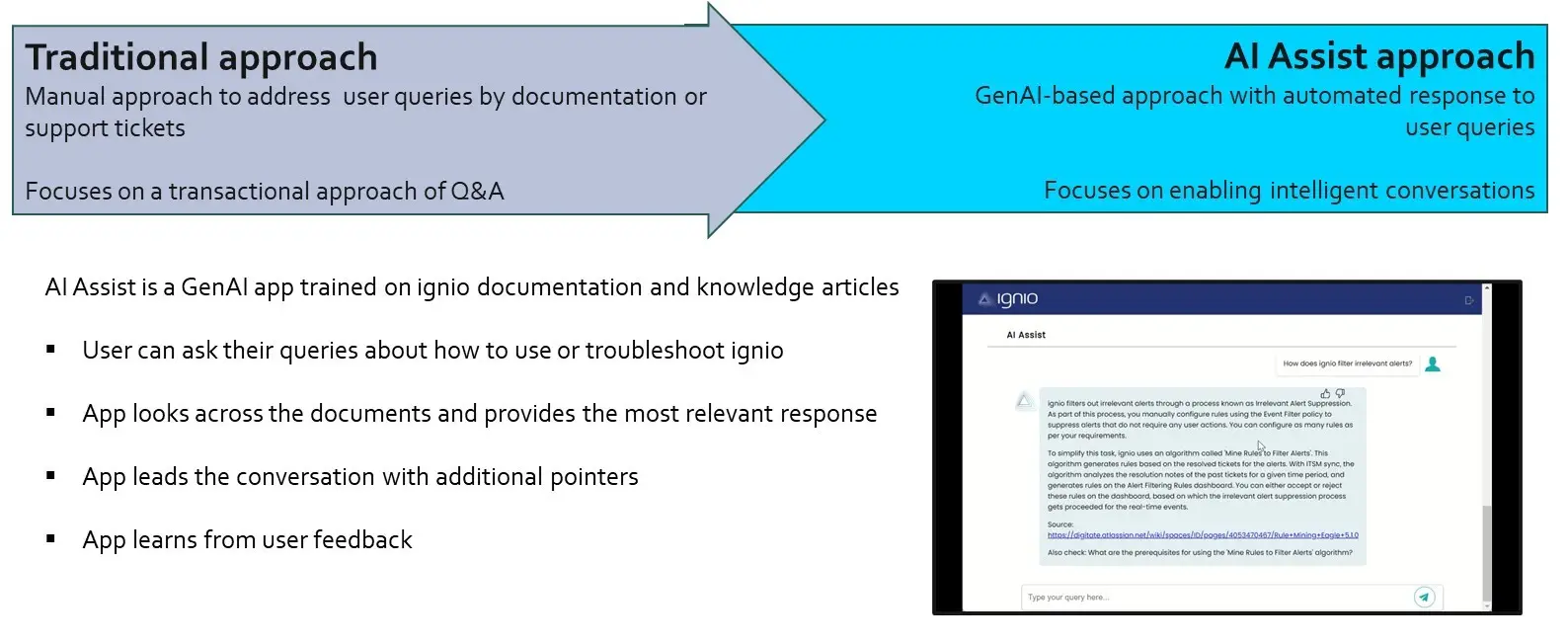
AI Assist – More than a Chatbot
Although it may seem as if AI Assist is just another Q&A bot, it goes far beyond that. In the world of conversational chatbots, there are the following three different levels of sophistication.
Level 1 consists of FAQ bots, which are programmed with a fixed set of questions and answers. These bots can only respond to specific questions that have been pre-fed into their system.
Moving up to Level 2, there are chatbots with predefined conversations. These bots are designed for specific tasks, for example, booking a flight ticket. They are equipped with pre-defined conversations for booking flights, making cancellations, and handling modifications. Users select appropriate options, and the bot guides them accordingly.
Now, Level 3 is where things get interesting, and this is where ignio AI Assist comes into play. Unlike the previous levels, users are not restricted from asking their queries in a specific format. They can enter their questions in any way they are comfortable with. AI Assist understands and even guide them in formulating their problem statements in appropriate way. It is well-equipped to handle the context and remember recent conversations, eliminating the need for users to repeat all details every time they interact with it. It is designed to handle ambiguities and seek clarifications from users, if needed. It learns from user’s feedback, allowing it to provide personalized responses based on the user’s preferences. In summary, AI Assist offers a sophisticated conversational experience that can handle complex conversations, provide personalized responses, and create a human-like experience for users.
AI Assist Design Rationale
AI Assist has been built on the following three key principles.
Principle 1 – Maintain a knowledge repository to enable intelligent search: AI Assist maintains a knowledge repository of ignio documentation which includes the product documentation, the how-to guides, as well as the knowledge articles used by the support teams. To enable intelligent search through this repository, it uses embeddings and vector stores to store this documentation.
Principle 2 – Enable a user-friendly experience: AI Assist ensures a user-friendly experience. Users can simply ask their questions in simple English language. The app understands language variations, understands conversation context, deals with ambiguous questions, and provides a response accordingly. Moreover, the response is also not pasted as-is from the reference document. It further post-processes the document content to generate a response in a crisply summarized and readable format.
Principle 3 – Enable intelligent conversations: The third most important principle that we have followed is not to make AI Assist a simple Q&A bot. AI Assist should drive intelligent conversations. This is where we leverage GenAI and NLP to learn the context, resolve ambiguities, lead the conversation, and learn from feedback.

AI Assist Key Features
Let’s look at some key features of AI Assist.
- AI Assist can answer different types of questions: You can use AI Assist in different ways. You can use it to summarize information from multiple documents, for example, “gimme a short summary of all the features of workload management.” Or you can use it to get a step-by-step guide, for example, “gimme a step-by-step guide to configure rules for alert suppression.” Or you can use it to get pointed answer to a specific question, for example, “Transaction watch is not visible; how should I troubleshoot?”
- AI Assist understands language variations: AI Assist does not require users to interact in a rigid format. Users can ask the same question in multiple ways and AI Assist will still be able to help with the right response. For example, a user can ask “how to use rule-based alert suppression”, or “gimme steps for rule-base alert suppression”, or “how can I use ignio to suppress alerts using rules”. AI Assist understands all these variations. It is often also tolerant to typos!
- AI Assist can deal with ambiguities: With no restrictions on the conversation workflow, users can ask their queries in any manner they prefer. However, this can result in vague, generic, or ambiguous queries. AI Assist deals with ambiguities by finding related content and helps users refine their questions. For instance, if you ask a question “dynamic data issue”, AI Assist will try to disambiguate the query by pointing to more specific scenarios, such as “dynamic data is not getting ingested”, or “dynamic data is not visible”. Thus, AI Assist is designed to prevent abrupt ending to conversations. Even if the input queries are vague or ambiguous, instead of simply stating that it does not have an answer to an ambiguous or unanswerable query, it takes a proactive approach by assisting the user in formulating their problem statement more effectively.
- AI Assist can lead the conversation: Instead of just replying to a user query, it also understands the context and leads the conversation with additional related content. For example, if a user asks a question “how to run batch predictions”, AI Assist can lead the conversation with more details, such as “how to view batch predictions”, or “how to configure prediction notifications”.
- AI Assist can learn from user’s feedback: AI Assist asks for user likes/dislikes and learns from it to improve its accuracy. It learns from this continuous feedback and employs a reward/penalty model to rank the answers to a given query. The more it gets used, the more accurate it becomes.
- AI Assist is guarded with responsible AI guardrails: AI Assist has meta-prompts in place to prevent hallucinations. It also has guardrails in place to detect and treat PII data as well as any harmful content.
AI Assist User Journeys
We foresee two types of user journeys with AI Assist.
- A user who is new to ignio will use AI Assist to know about ignio features and how they can help address user’s concerns. In the following example, a user wants to understand how ignio can help in managing events.
- How can ignio help me with event management?
- ignio can help with filtering, aggregation, ….
- Where do I start?
- Start with filtering, …
- How does it work?
- …..
- What are the prerequisites?
- ….
- How do I configure it?
- …
- A more experienced user, who has been using ignio and is well aware of its features, will use AI Assist to troubleshoot ignio-related issues, or to further enhance their use cases with additional ignio features. The following is an example conversation of a user who is already using ignio to filter alerts and now wants to do more.
- I am filtering alerts, but I am still getting noise. What more can I do?
- ignio can help in 4 ways: maintenance window- based filtering, duplicate filtering, …
- What is maintenance window-based filtering? How to configure it?
- …
- I have configured thresholds. I wanna improve it. What more can I do?
- …
- Gimme a step-by-step guide to do that
- …
- I want to review the rules before ignio applies them. Can I do that?
- …
- Where can I see the ignio’s effectiveness?
- …
Conclusion
The advances in NLP and LLMs are reimagining the human-machine interaction paradigms. Gone are the days of reading through user-guides, or using vanilla fixed-menu chatbots, or even raising support tickets. We are now entering the realm of intelligent conversations.


