


From the early days of enterprise IT operations (ITOps), focused on automating specific tasks, to today’s era of agentic orchestration where AI tools are capable of learning, adapting, and generalization, enterprise ITOps has come a long way.
In this post, we offer a glimpse into the journey of IT operations:
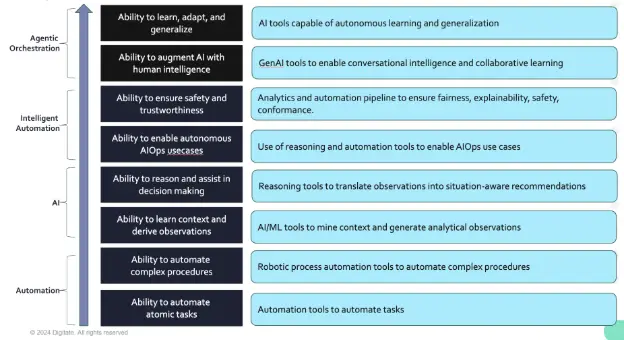
The evolution of enterprise IT operations
Automation in ITOps began to take shape in the late 1980s to early 1990s, but it started gaining traction in the early 2000s, when organizations started moving toward more structured and repeatable automation for specific tasks such as starting a service or checking disk utilization.
As technology got more sophisticated, Robotic Process Automation (RPA) tools could automate complex procedures such as patch management or resource fulfilment. These composite actions consisted of predefined rules to automate a standard operating procedure.
Then came artificial intelligence and machine learning (AI/ML), which was a significant turning point in ITOps. These AI/ML tools had the ability to process data, learn context, and generate analytical observations. Unlike the earlier version of automation, which followed static rules, AI/ML systems could learn from data and derive analytical observations.
AI/ML continued to evolve, enabling reasoning and informed decision-making. These tools leveraged context and domain knowledge to translate analytical observations into context-aware insights and recommendations.
Soon after, intelligent automation became the next big leap. Cognitive systems were developed that used reasoning and automation tools to autonomously perform various AIOps use-cases such as Event Management, Incident Management, and Problem Management.
With the extensive use of AI and automation for business-critical applications, responsible AI practices were developed to ensure fairness, explainability, trustworthiness, and compliance.
AIOps solutions need human guidance periodically to understand new situations, to capture tacit knowledge about a situation, or to review and validate AI-driven insights. As AI became more deeply embedded in operational workflows, the importance of integrating human insights along with autonomous decision-making had grown too. Advances in Generative AI (GenAI) made it possible to create human-agentic interfaces to augment machine intelligence with human intuition and experience.
And then came the showstopper – AI systems that not only learn but also adapt and generalize. Advances in Agentic AI is pushing the envelope further toward intelligent orchestration of various AI agents that are capable of autonomous learning and generalization. These agents bring the agency to act independently and purposefully while adapting to the changing environment, while learning and improving with time.


