


Business in the early nineties and before were operated differently than they are today. Business operations were decentralized since they were run out of multiple locations. Each location had its independent system of maintaining records which was the cause of several challenges for an enterprise as a whole. One of the challenges of decentralized operations was the cost factor.
To understand this better, let us consider a small example. A company who manufactures both refrigerators and air conditioners need compressors to make their products. This company’s manufacturing units are divided such that refrigerators are manufactured out of location one and air conditioners are manufactured out of location two. Both the manufacturing units procure compressors from two different vendors that are closer to each location. The refrigerator unit is procuring compressors at a certain cost, while the air conditioning unit is procuring compressors at a different cost.
Here, in an ideal situation, both the units should have been procuring compressors from a single vendor who provides them at a better cost, as well as qualify for bulk purchase discounts. But this does not happen owing to the decentralized operations. Both units are unaware of these transactions and hence the vendors are able to make merry out of this situation.
All of this changed, and for good when SAP ERP entered the market. Their solution was a powerful tool that integrated and centralized the master data system. This resulted in centralized business operations and hence the location of manufacturing units did not matter. For the company, a master data of compressors, vendors and their locations was created. This gave a clear picture of the total requirement in terms of material, volume, supplier and their price in one click. This data also reflected in the financial report of the company.
Master data is a central data repository which is used as a basic reference data for all transactions for different integrated modules. Master data is divided in two parts – client level and plant level data. Client level data is common for all and plant level data is different and plant specific.
Having a central master data provided the company with certain advantages, one of which is the control over unplanned inventory which was unnecessarily maintained earlier because of the lack of tracking, invisibility of stock and poor requirement planning. This resulted in many business units saving cost and efforts through effective Monthly Requirement Planning.
For enterprises, it is important to have accurate and error-free master data. Master data to an ERP system is what the heart is to the human body. If your heart is healthy, you are healthy. Similarly, if your master data is healthy then your ERP system is healthy.
According to business scenarios and industry type, there can be multiple master data used in ERP Systems, however, the following are the most commonly used by all businesses:
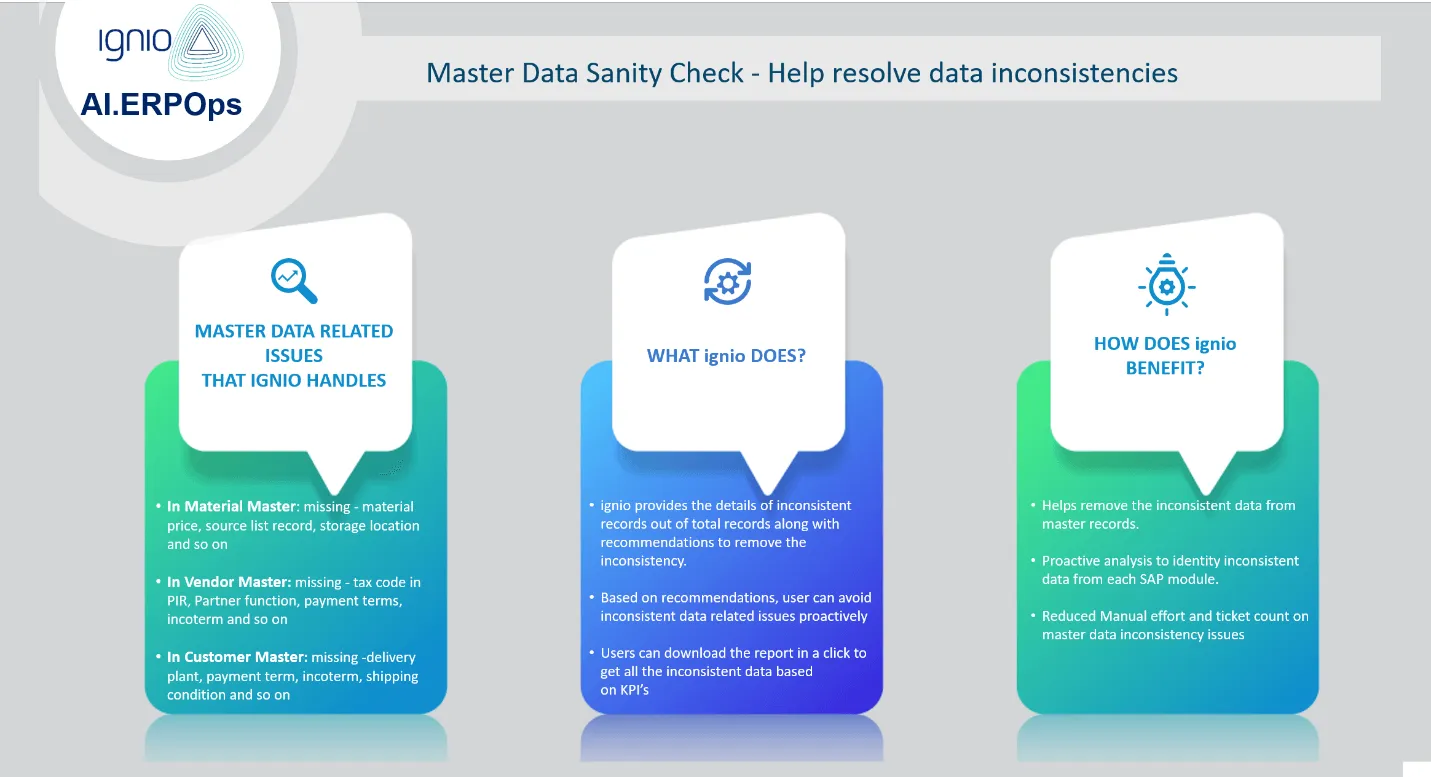 The following figures show Master Data Sanity Check Dashboard view with Materials, Customer and Vendor Masters.
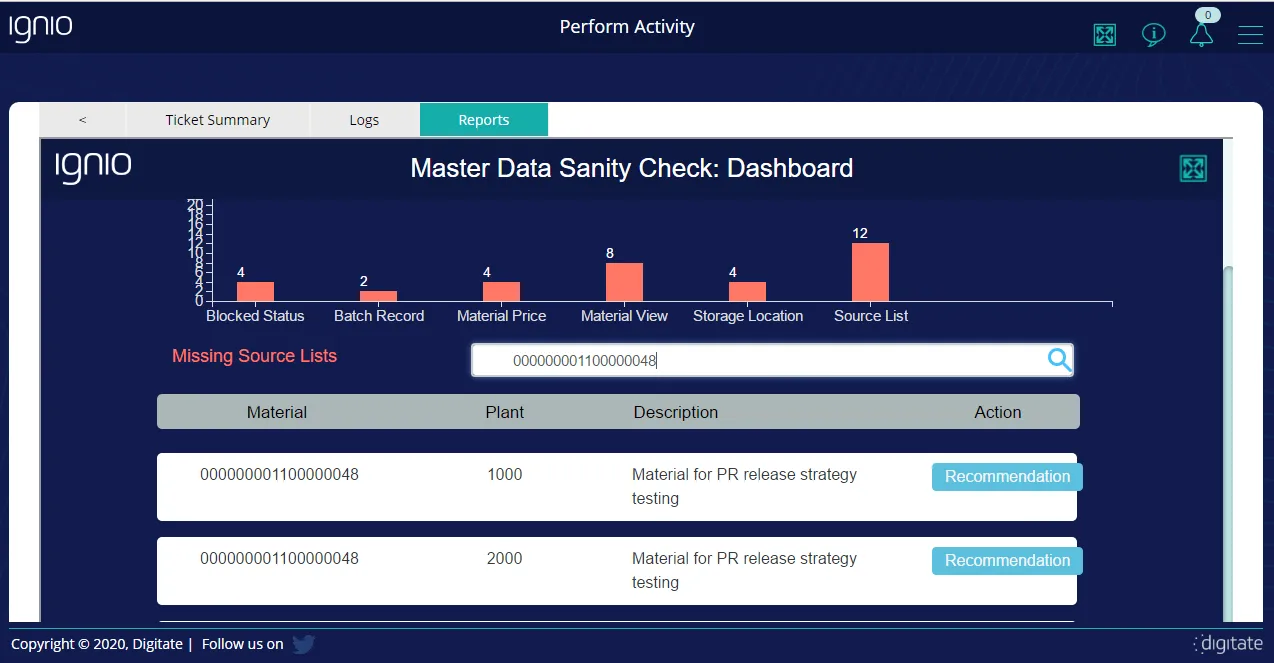
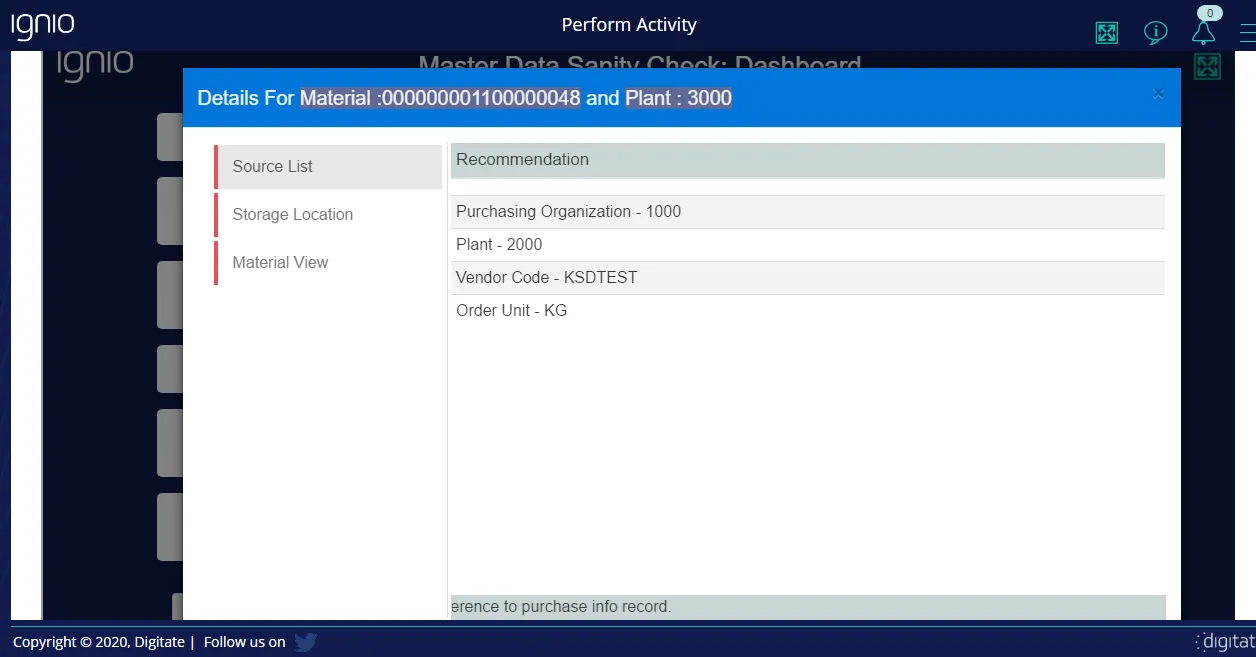
 Material masters KPI and Search option with Recommendations details in next screen.
 Thus, ignio AI.ERPOps proactively monitors your Master data and gets rid of Master data inconsistencies.
To know more about ignio AI.ERPOps visit: https://digitate.com/ignio-ai-erpops/
Thus, ignio AI.ERPOps proactively monitors your Master data and gets rid of Master data inconsistencies.
To know more about ignio AI.ERPOps visit: https://digitate.com/ignio-ai-erpops/
- Vendor Master
- Customer Master
- Material Master
- PIR (Purchase Info Record)
- Condition Master Record
- Higher Data Volume
- Inconsistent Data (Blank/Missing data)
- Incorrect Integration of Cross Module data
- Person specific dependency
- Lack of Data Monitoring, Analysis and Alerts
- Lack of Automation and Artificial Intelligence
- Lack of Master Data Inconsistency Reports
The following figures show Master Data Sanity Check Dashboard view with Materials, Customer and Vendor Masters.
Material masters KPI and Search option with Recommendations details in next screen.
Thus, ignio AI.ERPOps proactively monitors your Master data and gets rid of Master data inconsistencies.
To know more about ignio AI.ERPOps visit: https://digitate.com/ignio-ai-erpops/ 

