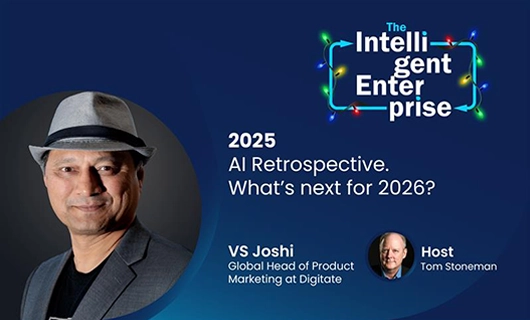

Tom Stoneman:
Hi, and welcome to The Intelligent Enterprise, the show where we get inside the real world tensions of enterprise technology by getting outside of them. I’m your host, Tom Stoneman, and this week we have a special guest, my colleague VS Joshi, who is the Global Head of Product Marketing at Digitate, and we’re going to be doing a holiday retrospective and 2026 outlook.
Welcome everyone. And VS, why don’t you go ahead and tell us a little bit more about yourself and what you do at Digitate?
VS Joshi:
Thank you very much, Tom. Thanks for having me here. My name is VS, VS Joshi. I am the Global Head of Product Marketing here at Digitate. And I have a small team of product marketing managers reporting into me, and we as a group are responsible for product positioning and messaging. We own the strategic narrative for the product portfolio, and we ensure that the messaging is consistent across websites, sales deck, campaigns, analyst briefings, partner materials, events and various other things.
Tom Stoneman:
Fantastic. So, we work together.
VS Joshi:
Yes.
Tom Stoneman:
Every day.
VS Joshi:
Yes.
Tom Stoneman:
All the time. So, I know a lot about what you do.
VS Joshi:
Oh my God, okay.
Tom Stoneman:
Inside and outside work. Not in a weird way. And I know you are a marathon runner, not just any marathon runner. You do this a lot. So, I mean, the only thing I know about running is watching Marathon Man.
VS Joshi:
That’s a good one.
Tom Stoneman:
So real quick here, just tell us, what was the most recent marathon that you’ve run?
VS Joshi:
Yes. I have run the Sydney Marathon. And yeah, so I just did it in a month of August. Yeah.
Tom Stoneman:
That’s a major one, right?
VS Joshi:
Yes. I am glad. I’m impressed that you know that Sydney is a major marathon because Sydney became a major marathon just this year. And yes, it is one of the seven major marathons.
Tom Stoneman:
So, how many major marathons have you run?
VS Joshi:
Well, I have run four of them. I run the New York Marathon, London Marathon, Chicago, and now the Sydney one.
Tom Stoneman:
Wow. That is a lot.
VS Joshi:
I just started running after COVID.
Tom Stoneman:
Well, we always know when you’re doing these because you’re gone and we get a lot of pictures. So, yeah. But it looks like a lot of fun. Tell us what you’ve seen that’s happened in 2025 with AI and machine learning.
VS Joshi:
Yes. I wrote a very little ebook back in 2022. It was really just a beginner’s primer to AI and machine learning. Now, since then, the world has changed dramatically. Okay? I mean, the real leap happened with the rise of generative AI. Now, AI stopped being limited to just classifying or predicting. It started creating. It started generating. It generated text, it generated audio, video, code, music, everything. And AI shifted from being a passive tool to becoming an active collaborator. Then the large language models, they became a centerpiece of this revolution. I mean, all of this was essentially the story of 2023, 2024. If you ask me specifically about 2025, the defining theme is AI agents and agentic AI. AI is no longer just predicting or generating. It is taking action, and this is the shift from AI as a tool to AI as a teammate.
Tom Stoneman:
I think we’ve all heard the terms agentic AI and AI agents being used pretty much interchangeably. For a layman’s terms, how do you differentiate between the two?
VS Joshi:
Now, agentic AI refers to a broader paradigm. It is a system of multiple AI agents collaborating to achieve a complex goal. Okay? You can consider it as a framework. It describes an architecture, a philosophy, where AI is not passive. It is not just answering prompts, but it is active. It is able to plan, adopt, learn, and pursue objectives. An autonomous vehicle, that is an example of agentic AI. Now, AI agents are a subset of agentic AI. An AI agent is a software entity that can perceive, reason, learn, adopt, and act in an environment to achieve a specific goal. Now, we call it PRAL, P-R-A-L, perceive, reason, act and learn. And AI agents, they usually focus on a specific task or a workflow. Example, IT incident resolution agent and event management agent, and these AI agents, they are built using the underlying AI techniques. They can be built on LLMs, ML models, rule-based stuff, or they can be composed.
We call it composite AI. I mean, that’s one of our differentiations. And AI agents generally, they operate within the defined boundaries, and usually one agent serving one function. Thus, an AI agent is optimized for a domain. It is optimized for a set of tasks or a slice of the enterprise operation. Now, Tom, you are a musician. Yeah? You’re a musician of some repute, I guess?
Tom Stoneman:
Well.
VS Joshi:
Okay. So, you’re a musician.
Tom Stoneman:
I am.
VS Joshi:
Okay. So, let me give you a musical metaphor. AI agents, they are the musical instruments and agentic AI is the orchestra.
Tom Stoneman:
That makes sense. That’s a good analogy. But I want to ask you another question. Are you saying that AI agents do PRAL while Agentic AI does not?
VS Joshi:
Oh, no, no, no. What I’m saying is Agentic AI is not a PRAL versus a non-PRAL thing. Agentic AI is PRAL at scale. And again, PRAL means perceive, reason, act, and learn. So, Agentic AI is PRAL at scale, across multiple agents working together. Agentic AI, it coordinates many PRAL capable agents. It aligns them towards a shared goal. It synchronizes decisions, timings, and handoffs. Now, just like the orchestra, the magic of agentic AI is the collective behavior, not the individual capability.
Tom Stoneman:
That makes total sense.
All right. So just to move it forward here a little bit, we wanted to cover a couple headlines for 2025.
VS Joshi:
Yes, this is a holiday season. Yeah.
Tom Stoneman:
We’re there. We are there. Yeah. So, as 2025 comes to a close now, we thought it would be a good time to look back at some of the major developments in AI. We pulled together a mix of some things and picked a couple out. So, let’s get into that.
VS Joshi:
So, let me ask you, Tom, I know you’re a musician. So, can you talk about what are the effects of AI on the music industry and on musicians and things like that?
Tom Stoneman:
Yeah. So, we’re going to have to have a whole separate podcast, I think, for this, right? There is so much going on with that. It’s changing by the day. I think the most interesting things that I see are the artists that are generating songs using AI and then rerecording them and putting them out. I think more and more artists are integrating AI into their processes and that’s changing everything. But the funniest one I think is there’s a country song out there, AI generated. It’s got 2.2 million listeners. And I was doing some listening this morning and there was a lady who was, they were interviewing some people about what they thought about this. And some of the songs are beautiful, right? The inflections and the emotions and everything are just perfect.
And this lady heard one of these songs, it was a country song, and it was really good. I listened to it. And the guy asked her, he said, “You know she’s not real, right? I mean, you’re never going to be able to see this person ever.” And she knew, but she says,” That’s just so sad. I’m never going to be able to see this person because I love the song so much and I would love to be able to see.” So who knows, maybe that’ll change here. And there are a lot of AI generated videos now.
But it’s really turning creativity on its head, I think. I mean, when I look at the history of this, I go back to, I was at the Cleveland Institute of Music years ago, back in the mid ’80s and early ’90s, and we were kind of ground zero for when sampling was becoming a thing, and it wasn’t before that. So, we kind of became the center of something because one of the students had sampled the Cleveland Orchestra, which was right down the street from us, to use in an advertisement on the radio. But instead of having to pay the royalties to the guys that own the masters, he just took this in, took the sample of the recording and we put it into the Synclavier, and then rerecorded it with that, which takes that out of the picture, right?
Well, they didn’t like that. Now, we’ve got the exact same thing happening now. Who owns this, right? When AI generates it, who’s the owner? That’s a big thing. So, that’s what I see happening. But for me, I see in 2026, AI really democratizing music in good ways and not so good ways, and also being used by artists to do some things that I don’t think we’ve ever heard before. So, I think it’s going to be an exciting year.
VS Joshi:
One question is whether they will kill the creativity part of it though.
Tom Stoneman:
Well, they don’t, because if you look at how some of these guys do it, I mean, I think everybody knows Brian Eno, years ago, 2017, he did an album called Reflections and he took a generative music player basically, an early version of it and created a whole album with it that essentially can run till the end of time creating music, right? But he programmed it with his stuff that he wanted. So, if you have the right artists and you have the right visions, I think there’s still going to be really good stuff. But you’re right, we’ll see what happens.
So VS, tell us what you’ve found.
VS Joshi:
Okay. So, I want to talk about botched launch of a product, and this is, I’m talking about this was all the news in Jan 2025 or so, and French AI chatbot Lucy was launched in Jan and it was pulled after this bot gave bizarre answers. And to think of it, the people behind it was the President of France, Macron, okay? It was a French government and essentially Lucy was supposed to be a French language, open source, large language model-based chatbot. And it was France’s national investment plan. It was positioned publicly as a sovereign French European alternative to the large English language generative models that were dominating the market like OpenAI. And France wanted to reduce its dependence on American-Chinese large language models and to build an AI asset that better reflects the French or the European language, its culture, values, and digital sovereignty.
So, to think of it, that this particular launch was done and it started giving some random answers. If in case it was asked, what is a square root of a goat? It answered one, which is of course nonsense. And it claimed that cows, eggs were edible eggs produced by cows, a source of protein and nutrients. So, yes, here was a premature public release of a product. The developers admitted that the model was still an academic research project in its early stage and that it was launched too early. Again, this is very close to my heart because I’m in product marketing. We are involved with launching of products and portfolio products and software releases and things like that.
Now, this caused a reputational risk and public critical by entire, not only by French, but the entire world, because I think he was trying to get ready for some AI symposium that was going to happen in France at that point in time, and it just became a subject of mockery and negative media coverage. So, I think again, again, I’m just putting my marketing hat over here. So, I was just, what was the learning from this? It feels that the launch readiness matters. Having a strong brand, high ambition or large backing, that’s great, but it does not replace the foundational performance. It’s better to launch the beta of a product, yeah? And clearly labeled as better with caveats rather than presenting a research prototype as a mature product.
And they didn’t highlight the transparency about its limitations and scope, and messaging and brand alignment matters, but that must follow substance. And somehow the substance was not there. So, that was a very interesting story for me, the botched launch of French government’s Lucy chatbot.
Tom Stoneman:
You’re saying cows don’t lay eggs?
VS Joshi:
Not when I checked last. I don’t know whether AI has made tremendous progress and cows are also doing that. I have no idea. But this is indeed a problem with AI. This is a challenge of AI. Hallucination is a challenge. Yeah. I mean, what kind of data is input, that becomes a challenge. The data itself might be a biased data. So, hallucination is a challenge. Biased data is a challenge. And going forward, I feel that those will be the things where a lot of tightening will going to happen and we are going to make the models much stronger. The researchers, they are phenomenal researchers who are working in this field. They are definitely going to take that challenge, and we are onto better world, I guess.
Tom Stoneman:
Yeah.
VS Joshi:
And cows won’t lay eggs then, yeah?
Tom Stoneman:
Well, there is a thing called, and it’s pretty negative, but it’s called artificial stupidity, right? It’s out there.
All right. So now, let’s shift gears. 2026, just around the corner. So, in this next segment, we’re going to share where we believe the industry is heading. So, let’s talk about the trends and the challenges that will shape AI next year. VS, what is your vision for ’26?
VS Joshi:
Okay. So, 2025 was clearly the year of AI agents and Agentic AI. And from whatever I’m seeing in the marketplace, I feel that 2026 will be the year of autonomous systems, a tipping point where AI becomes truly embodied within the business processes. So, instead of isolated tools and Copilots, organizations will deploy AI entities capable of perceiving reasoning and learning and acting, and executing actions across complex environments. And these embodied AI systems won’t just automate tasks. They will orchestrate the entire workflow. They will collaborate across domains and evolve their own strategies in real time. So, from my vantage point, I can say autonomous systems and embodied AI is where the whole thing is going in the year 2026 and beyond.
Tom Stoneman:
Perfect. Awesome.
VS Joshi:
Here is another thing that is definitely going to happen. One is, AI is going to be invisible and it is going to be embedded everywhere. The notion of AI being just a part of life, integrated, continuous, embedded, that will continue. And in 2026, it will become even more normalized. Now, the agents that we talk about, the AI assistance that we talk about, we will move from AI being assistive to autonomous agents. The term Agentic AI that we talked about in the PRAL at scale, perceive, reason, act, and learn at scale, it will move from hype into real enterprise adoption. And another thing I would like to say is AI in the physical world and infrastructure. So, beyond pure software, physical AI, I mean, we also call it embodied AI, robots, autonomous vehicles, smart factories, that will gain tremendous amount of traction. And all the infrastructure bottlenecks will come more into focus.
In fact, one academic forecast shows massive growth in AI agent instances between 2026 to 2036, and there’s going to be infrastructure saturation. And there are implications of this thing in enterprise IT/OT settings. So, we should expect tighter integration of AI agents with physical systems, and a corresponding need for governance, safety, hybrid human machine workflows.
Tom Stoneman:
That’s insightful. I think that’s a really strong look at what you see coming. Yes, thanks.
VS Joshi:
Yep. So Tom, I would like to hear your view of things as to how things are going to proceed in 2026.
Tom Stoneman:
Yeah. It’s interesting doing this podcast series. I’ve heard a lot of different views from people, but there are some commonalities. So, I’m going to start with those. I think the big things that I’m hearing that everybody sees coming is the interaction between AI and humans. That seems to be something that it’s both worrisome and then it’s also a huge opportunity. So, that to me is one of the big significant things that has to be dealt with, is how are we going to interact with AI? And that goes across all different parts of enterprises, right? So, everything from the IT organizations to the marketing organizations, which you and I, we see this all the time, ChatGPT is already changing the way we do things, all the way to how leaders are able to both comfort and guide their employees so they can start to learn new skills.
Because, I mean, frankly, a lot of skills are going to go out of, they’re just not going to be needed as much, right? But you don’t want to lose the people because the people are the company. And so, that’s what I see being one of the big challenges and one of the opportunities is how are we going to have these two things kind of meld together?
VS Joshi:
Yes. I think human and AI collaboration will indeed be the big thing going forward. Yeah. I mean, I think some, I don’t know who said this thing, but they said human by itself will not be sufficient. AI by itself will not be sufficient. But the combination of human plus AI, that is going to be a killer combination going further.
Tom Stoneman:
Exactly. Well, VS, this was a ton of fun. We were able to look at 2025, kind of where we are today, and we gave a little taste of what we see at least coming in 2026. Really appreciate your coming on the show. I know there’s a lot going on right now. It’s a busy time, so we’re just thrilled that you could join us.
VS Joshi:
Hey, it was fun. It was absolutely fun. Call me again. I’m more than interested in coming back again. Thank you so much. It was so much fun.
Tom Stoneman:
Thanks. It’s pretty easy, you just sit right across from me.
Thank you for listening to The Intelligent Enterprise. I’ve been your host, Tom Stoneman. Remember to follow the podcast and leave a comment or review wherever you get your shows. See you in the new year.

Digitate’s empowers organizations to transform their operations with intelligence, insights, and actions.
Redefining IT operations with AI and automation
Enabling predictable, Agile and Silent batch operations in a closed-loop solution
End-to-end automation for incidents and service requests in SAP
Autonomously detect, triage and remediate endpoint issues
AI-based analytics to improve Procure-to-Pay effectiveness
Transform software testing and speed up software release cycles
Digitate helps enterprises improve the resilience and agility of their IT and business operations with our SaaS–based platform.
ignio™, Digitate’s SaaS-based platform for autonomous operations, combines observability and AIOps capabilities to solve operational challenges
Autonomous IT Solutions for the Modern Industry
ignio’s AI agents, with their ability to perceive, reason, act, and learn deliver measurable business value and transform IT operations.
Discover how we empower customer success and explore our latest eBooks, white papers, blogs, and more.
Discover what top industry analysts have to say about Digitate
Get insights from the Forrester Total Economic Impact™ study on Digitate ignio
Explore our upcoming and recorded webinars & events
Discover the capabilities of ignio™’s AI solutions
Explore insights on intelligent automation from Digitate experts
Digitate policies on security, privacy, and licensing
Digitate ignio™ eBooks provide insights into intelligent automation
Explore our upcoming and recorded podcast
Learn how businesses overcame key AI-driven automation issues
Guides cover AIOps and SAP automation examples, use cases, criteria
A library of in-depth insights and actionable strategies
At Digitate, we’re committed to helping enterprise companies, realize autonomous operations.
We’re committed to helping enterprise companies realize autonomous operations
Explore the latest news and information about Digitate
Grow your business with our Elevate Partner program
Evolve your skills and get certified
Get in touch or request a demo
Digitate’s empowers organizations to transform their operations with intelligence, insights, and actions.
Redefining IT operations with AI and automation
Enabling predictable, Agile and Silent batch operations in a closed-loop solution
End-to-end automation for incidents and service requests in SAP
Autonomously detect, triage and remediate endpoint issues
AI-based analytics to improve Procure-to-Pay effectiveness
Transform software testing and speed up software release cycles
Digitate helps enterprises improve the resilience and agility of their IT and business operations with our SaaS–based platform.
ignio™, Digitate’s SaaS-based platform for autonomous operations, combines observability and AIOps capabilities to solve operational challenges
Autonomous IT Solutions for the Modern Industry
ignio’s AI agents, with their ability to perceive, reason, act, and learn deliver measurable business value and transform IT operations.
Discover what the top industry analysts have to say about Digitate
Explore Insights on Intelligent Automation from Digitate experts
Get Insights from the Forrester Total Economic Impact™ study on Digitate ignio
Learn how Digitate ignio helped transform the Walgreens Boots Alliance
Digitate ignio™ eBooks Provide Insights into Intelligent Automation
Discover the Capabilities of ignio™’s AI Solutions
Guides cover AIOps and SAP automation examples, use cases, and selection criteria
Discover ignio White papers and Point of view library
Explore our upcoming and recorded webinars & events
At Digitate, we’re committed to helping enterprise companies, realize autonomous operations.
We’re committed to helping enterprise companies realize autonomous operations
Explore the latest news and information about Digitate
Grow your business with our Elevate Partner program
Evolve your skills and get certified
Get in touch or request a demo

Digitate’s empowers organizations to transform their operations with intelligence, insights, and actions.
Redefining IT operations with AI and automation
Enabling predictable, Agile and Silent batch operations in a closed-loop solution
End-to-end automation for incidents and service requests in SAP
Autonomously detect, triage and remediate endpoint issues
AI-based analytics to improve Procure-to-Pay effectiveness
Transform software testing and speed up software release cycles
Digitate helps enterprises improve the resilience and agility of their IT and business operations with our SaaS–based platform.
ignio™, Digitate’s SaaS-based platform for autonomous operations, combines observability and AIOps capabilities to solve operational challenges
Autonomous IT Solutions for the Modern Industry
ignio’s AI agents, with their ability to perceive, reason, act, and learn deliver measurable business value and transform IT operations.
Discover what the top industry analysts have to say about Digitate
Explore Insights on Intelligent Automation from Digitate experts
Get Insights from the Forrester Total Economic Impact™ study on Digitate ignio
Learn how Digitate ignio helped transform the Walgreens Boots Alliance
Digitate ignio™ eBooks Provide Insights into Intelligent Automation
Discover the Capabilities of ignio™’s AI Solutions
Guides cover AIOps and SAP automation examples, use cases, and selection criteria
Discover ignio White papers and Point of view library
Explore our upcoming and recorded webinars & events
At Digitate, we’re committed to helping enterprise companies, realize autonomous operations.
We’re committed to helping enterprise companies realize autonomous operations
Explore the latest news and information about Digitate
Grow your business with our Elevate Partner program
Evolve your skills and get certified
Get in touch or request a demo