

Tom Stoneman:
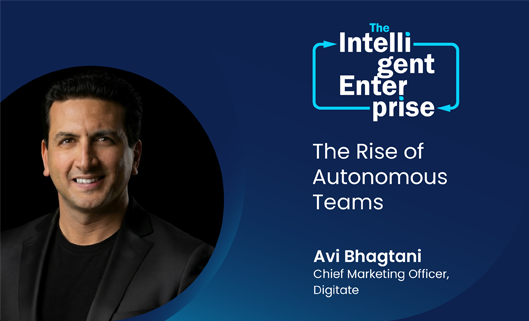
Hi, I’m Tom Stoneman, and this is The Intelligent Enterprise, where every two weeks we take a break from the chaos of enterprise life and get inside a big idea by getting outside of it. Each episode, we meet an industry expert who helps us cut through the noise from all the updates and rollouts while exploring one of their favorite breaktime activities. Things like hiking, cycling, reading, whatever activity gives them a reprieve from the day-to-day demands of work and the distance they need to come back to a problem with a fresh perspective.
This week, I’m joined by Avi Bhagtani, the chief marketing officer at Digitate. His extensive experience includes leadership roles in software, product, and marketing at both high-growth tech startups and Fortune 500 companies.
Avi Bhagtani:
I sit at the intersection of product sales and customer success, and what that helps me do is it helps me translate complex technologies into outcomes that the business leaders really care about.
Tom Stoneman:
And that’s fitting because this episode will be all about taking something complex and breaking it down into actionable insights. Digitate recently published a report based on the results of a survey we conducted with over 600 IT decision makers across North America. The aim of the survey was to get a better picture of how AI tools are being implemented across workplaces, and the results are absolutely fascinating.
Avi Bhagtani:
Adoption is now based on an outcome. I want to use AI for the sake of AI or someone’s telling me to use AI, those days are gone. I think people have very clear expectations of what AI is supposed to do for them.
Tom Stoneman:
Let’s get inside the future of enterprises by stepping outside of them.
Well, today we’re going to discuss your insights, in particular, on the recently published report I just mentioned from Digitate. This report provides an in-depth view of how agentic AI is influencing enterprise maturity, operational performance, based on responses from more than 600 IT decision makers across North America. These are decision makers primarily at large enterprise companies that we’ve talked to over the last year. So let’s start right at the top, we’d like to hear what your key takeaways from this report are.
Tom Stoneman:
Yeah, no, I appreciate that, Tom. But if you’d allow me, before we get into the report, I want to just talk about the premise and set the context a little bit for the audience. See, if you look at the evolution of IT over the last couple decades, it’s moved in some very clear ways.
First was automation. We were focused on scripting tasks that were very repetitive, with the intent of reducing manual effort and driving efficiency. Very rule-based, very deterministic. We knew what we were supposed to do, and we were doing it with the help of automation. Then we shifted into AI. That’s when systems started learning from data, instead of just following some predefined rules. AI brought prediction, some pattern recognition, anomaly detection, things like that, that typically was very human in nature to do. It wasn’t just about doing things faster, it was about doing things smarter.
Today, where we are is that we are entering the autonomous era in IT, and that’s a much bigger leap. Autonomous systems don’t just detect or recommend, they decide and act. They’re self-healing. They adapt in real-time. They continuously optimize without waiting for human intervention. For enterprises, that’s transformational. And if you look at the first two dimensions, there’s been steps, but now we’re almost leaping into this autonomous era. We’re moving from reactive IT to predictive IT to truly self-operating IT. That changes cost structures, changes resiliency, and even how teams are structured, effectively changing the way people do work in IT. It frees up people from firefighting so they can focus on innovation and strategic impact.
The study that you mentioned captures insights from 600 IT decision makers in largely North American enterprises, all of whom have implemented AI within just the last 24 months. It reflects organizations that are not just exploring AI, but they’re actively deploying it at-scale and making the findings grounded in real-world adoption and experience of what these IT leaders and IT operators are doing inside of enterprises.
Tom Stoneman:
One of the things I saw or picked up when I read this is it feels like we’ve moved from experimenting with AI to actually scaling it so that there’s a measurable ROI. They’re likely transitioning from experimental pilots to integrating AI as a core structural component of their operation. What do you feel the survey data tells us about how people in enterprise organizations are using AI today?
Avi Bhagtani:
Organizations are moving beyond experimentation, just like you said, and embedding AI into core operations, and this is a big shift. What’s leading the way, and this is what the survey is telling us, that generative AI continues to lead that option. Today, 44% enterprise IT, from our survey results, have introduced agentic or agent-based AI into their conversations. This is huge.
Effectively, what that’s doing is that while GenAI continues to lead the adoption, there’s a growing segment that is moving towards agentic, action-oriented AI systems, and that’s big. Now, there might just be the early part of intent from their part, but this the leap from intent, to experimentation, to adoption has become much faster.
I’ll give you some more data points from what we learned. The biggest [inaudible 00:05:45] that are showing up are in productivity, speed and accuracy. There are organizations that are seeing anywhere up to 45% increase in productivity. This is huge. Automation could not get to those scales. This is across all systems with measurable improvements in decision-making and customer experience. Companies are using AI to simplify increasingly complex IT environments. They’re using it to strengthen financial performance. And to see that IT organizations are using AI technologies, generative AI technologies, agentic AI technologies to help strengthen financial performance, there is excitement around this.
Also, what the survey tells us is that we’re starting to address structural challenges like technical debt. Can I reduce my technical debt in IT? One of the biggest questions has been asked for the last 30, 40, 50 years. Today we are at the point, with data, and insights, and analytics, we can actually say that. You will see this throughout the survey. 46% of the survey respondents, they said, “We use AI to reduce operational complexities.” 40% are using it for better financial performances, and so on, and so forth. That’s quite refreshing to see. Overall, AI is shifting from a tactical tool to a strategic lever for organizations, and it’s across resiliency, efficiency, and organizational growth.
Tom Stoneman:
So in this report, one thing I saw that was stunning to me was that every single person that you talk to in here, all of these IT leaders, every single one of them had started implementing AI in some form or another.
Avi Bhagtani:
That’s right.
Tom Stoneman:
Which two years ago it was like 30%, right?
Avi Bhagtani:
Yeah. Yeah.
Tom Stoneman:
So big change there. Let’s talk about the rate of adoption for agentic AI. We’ve seen some patterns with agentic AI over the years, like shifts from simple chat bots to autonomous, multi-step workflows. As AI matures, what do you think that momentum will bring us in 2026?
Avi Bhagtani:
Yeah. No, Tom, that’s a really good question. See, agentic AI we truly believe that it’s the next step in the evolution of enterprise AI. Unlike traditional AI that analyzes and recommends, agentic actions can reason, they can perceive, they can adapt, and more importantly, act to some extent autonomously or semi-autonomously towards very clearly defined goals. What you’re doing is you’re moving away from a system of insights into basically a system of decisions. With that, AI agents are very task-specific when it comes to implementation, whether that’s resolving a ticket in IT, if they’re optimizing workflows, or managing parts of a business process. What’s powerful is that most IT leaders don’t see their systems as replacements, and that’s very important. In fact, a majority of them view them as your own partners in this. It’s not just removing humans from the loop, it’s amplifying human judgment at machine scale. Let the agents handle the repetitive, real-time execution while the humans can focus on context, strategy, and higher order decision-making.
What that does is that the business impact of that is tangible. IT is spending less time firefighting, and we’ve said this for years, that IT needs to be less reactive, more proactive, and the eventual goal of bringing in as much autonomy as possible, again, at machine scale. Decisions become more data-driven and consistent, and ultimately you start to see measurable outcomes, whether that’s cost, or efficiency, resilience, performance. Agentic AI is not just an upgrade to automation. It’s not an automation upgraded, it’s augmentation at scale with humans combined with machines.
Tom Stoneman:
Avi, based on what you just said, I’m sure there are some things in there that caught your eye. What surprises did you see in there?
Avi Bhagtani:
First of all, GenAI leading the adoption isn’t surprising. The meaningful move towards agentic AI does stand out. We were a little bit surprised when we saw the results coming back that IT organizations have plans already to move to agentic AI, which is refreshing. What that tells you is that organizations aren’t just satisfied with AI that creates content or insights. They want to take action. They want intelligence systems that can help them make decisions. That’s different.
One of the thing, and I wouldn’t call this a complete surprise, but it’s good to see, is that the strategic use cases are telling. Nearly half are using AI to reduce operational complexity. That’s big. It means AI isn’t just being layered on top of existing systems, it’s being used to sort of remove this complexity and technical debt. That’s a structural shift. That is a true structural shift. I think this is one of also the reasons why we’re seeing that hockey stick adoption, if you may, of some of the AI technologies.
Tom Stoneman:
There was a section in the report that was pretty interesting, and a little bit different. I didn’t expect it, and it was talking about the trust story. So confidence in AI, despite the complexity of AI. What does the survey data show us about trust in AI?
Avi Bhagtani:
Yeah, no, this one was interesting. In general, the trust in AI is quite high. This is different from what it used to be many years ago. I think what the data showed us, and again, we have to caveat this, this is a North America survey, so markets have different responses to questions like that. What we saw was that greater than 90% of the leaders say that they trust AI in some way, shape or form.
Quite interesting was that if you look a little bit closer, there are some nuances, right? The C-suite is leading the way. I think this is a little more pervasive. We all hear it all the time, “Hey, use AI as much as possible so that it makes your life better.” We’re hearing this. I’m sure you’re hearing this, I’m hearing this, across the board, but C-suite leading the way with more than 50 to 60% seeing that AI is trustworthy, I can trust it to do what I’m expecting to do, but more importantly, execs are seeing the big picture and the strategic value that AI brings in.
It also tells us that while people are optimistic about AI, confidence can vary depending on role and experience with the technology, probably even with regions. We do the survey once every year and we expand the survey, globally. It’d be interesting to see what some of the other markets are doing and how are they reacting to the same question. Do they have the same trust in AI that many organizations in North America have? We don’t know. It might be higher, might be lower, but I’m very curious to see the data when it comes out.
Tom Stoneman:
Yeah. There was one thing that I saw in there that caught my eye, and it was that people that are using AI have a much, much higher degree of trust than people that aren’t using AI. The hands-on when they see, oh, okay, this is what it does.
Avi Bhagtani:
Yeah. Look, see, at the risk of being preachy, as an organization, we are moving, at Digitate, to as much as possible an AI first organization. Obviously, our products started this journey almost a decade ago, but even inside our business functions, we’re trying to become the organization that uses AI, especially in tasks that can be done at, not just a faster level, but the output is much more beneficial to the organization.
But you’re right, I think that initial resistance to AI comes because there is generally a fear of, “Oh my God, this is too complicated.” I would encourage anybody that is listening to this conversation because it all sounds like AI, AI, AI everywhere, but what is important is to break that fear and get into it with a very clear purpose and outcome, and not just about summarization and some of the early tools like ChatGPT or just for answers. I would start using it for making some decisions or doing some tasks that was something as simple as maybe uploading a bunch of contacts into a list. We do that every day as marketeers.
But the more important thing is you break the problem down. You break the problem down and you can sort of basically start solving the smaller problems, but at the expectation that you’re going to get an output out of it. It is not just AI for the sake of AI. It is AI for making your job better, your life better. That’s the idea.
Tom Stoneman:
So then, Avi, how would you interpret that tension that you just described between executive confidence and frontline reticence, or caution?
Avi Bhagtani:
Yeah. Again, it’s a great question and a fantastic segue. In my opinion, there is an interesting tension here. See, like I said previously, many of the executives have started to see the big picture. They understand what are the strategic benefits and potential of AI. So their confidence is obviously a little bit higher. Frontline teams, on the other hand, they’re more closer to day-to-day operations. I mean, they’re dealing with complexity, edge cases and risks in real-time, but also there is a time commitment. They have to balance all of these things. So they’re obviously naturally more cautious.
It’s not the lack of trust. Again, we covered this. Trust for AI is now a little more pervasive than it was some years ago. It’s just practical realism, in my opinion. The keys is bridging that gap. You want to give the frontline teams the right tools, the transparency, and more importantly, the coaching. This is where the human element of leadership comes in. It’s not just by throwing a bunch of tools and saying, “Hey. Go make this happen. Everybody else can make it happen.” I think that’s where this gap becomes wider. When leaders step in and say, “Hey, I’m going to give you all of this tools, there is the training, there is a human element of it, there is time to learn, grow, mature with it.” I think leaders are understanding that that is the right balance of human empathy and organizational productivity. I think where the right balance is, I think the output is much better. The output with AI, the keenness to use the tools that are available to make them better, and that balance is extremely critical.
Tom Stoneman:
So a while back, everybody was thinking, “Well, yeah, okay, AI is going to come in and we won’t need people really to do that much anymore.” We’re finding out that’s not the case. The quote that is in there is, “Enterprises question how to sustain value amid limited human capacity. The winners will be those who balance automation without eroding the human expertise that powers AI’s success.”
Avi Bhagtani:
There is no AI without mentioning a human in the loop. Let’s just be very clear. The reason is the balance of productivity and that strategic decision making at the right points is what is going to make the entire journey very successful. I agree with the quote that’s there, and I think it’s a real powerful one.
Tom Stoneman:
The survey results that Avi describes paint a picture of a world where AI’s use is in flux. We seem to be past the era where AI was novel, or exploratory, and now appear to be in a phase where it’s become integrated into the day-to-day tasks for IT professionals. At the same time, the emergence of agentic AI presents opportunities for greater AI autonomy that could go beyond boosting efficiency, to identifying new avenues of value creation. For these new systems to fulfill their vast potential, it’s going to require people to stay in the loop and use their expertise to guide them, but people aren’t machines. We need to find ways outside of work to decompress and keep us sharp. Avi’s preferred method for doing that happens to be shared by millions of people around the world.
What’s your breaktime activity? What do you do when you’re deep in a problem?
Tom Stoneman:
My breaktime activity, just like anything else in life, is I don’t like to make things easy, for some reason, so I pick soccer as my go to. It’s where I go when, either I’m deep in a problem, or I just want to get away from everything. I chose soccer because it demands everything from you technically, physically, and mentally. It’s not just about talent, it’s about discipline, it’s about consistency. The game punishes you when you switch off for a second, and that’s the challenge I love.
It probably doesn’t help me switch off completely, but what it has helped me do is it takes my life to a dimension that re-energizes me to come back and do what I’m doing even better. Outside of what that sport brought, I think the most important thing that I learned was that it was the most inviting and everyone was equal. Really, no one mattered who you’re playing with. A bunch of people just showed up. If five people playing, six people showed up and it became 5v5, or 11v11, 10v10, doesn’t matter. It was a sport that was basically, it brought everyone together. As you can see across the world, you’ve got the World Cup coming up in a few months here, this close to home. That’s what started me about it, and that passion still continues. I play at least once a week, as much as time permits. It keeps me grounded. You win some, you lose some, just like life and work. It’s extremely rewarding. It’s been there with me for many years now, as long as the body keeps going.
Tom Stoneman:
So just to move in here now to our last segment here and talk a little bit more about the human part of AI and some of the questions that were asked in this survey.
Avi Bhagtani:
Right.
Tom Stoneman:
What do you feel are some of the barriers to AI adoption that you found in the survey, and how enterprises are overcoming them?
Tom Stoneman:
The survey obviously has a lot of exciting nuggets. There’s this general feeling that AI is moving in the right direction, but make no mistake, AI adoption still has hurdles, sometimes big hurdles.
In my opinion, I think talent is the biggest one. Skilled people are needed to build and manage AI. Also, skilled people are needed to train the unskilled people into AI, and that’s extremely important. It is extremely important that enterprises understand that gap and find the best ways with human empathy to fill that gap. Why I’m saying that is that if it’s an either/or answer, then that gap keeps getting bigger and bigger. You know the fear we talked about of getting into AI, that gets bigger and bigger. I think it is imperative that organizations, enterprises look at their talent maps, their talent skills, and try to bridge that gap. It’s not a be all end all.
I think again, the other thing which is sort of important, in my opinion, with enterprises is, a little bit of the non-human element of it, is that the costs are also very high. From compute to compliance, as AI pushes the cost barriers, leaders are expecting faster ROI. What does that do? You’re putting even more pressure on your talent and [inaudible 00:20:18].
It’s a very interesting conundrum. It’s also very interesting dynamic. At the same time, it’s also a very interesting intersection and an inflection point. My feeling is that I think people leaders need to play an equally important part. Again, like I said, many companies who are leading this, and we’d like to believe we are one of them as well, they’re overcoming this by training teams. They’re starting with what is the most high impact use cases that I can justify my cost, and then building capabilities across that spectrum; technology capabilities, execution capabilities, the human capabilities in a structured and step-by-step fashion.
Tom Stoneman:
As a leader, what is something that you would recommend to other leaders to help navigate this?
Avi Bhagtani:
Leaders need to balance short-term pressure with long-term capabilities. This is important. That means that you want to set realistic expectations, you want to invest in training, human capital. And starting with high impact projects that show the value quickly. Like I said, you have to break this into some very measurable things that can show impact as soon as possible. At the same time, you need to build the right infrastructure and governance so AI can scale, and this is something that’s very important to me, scale safely and sustainably. You want to move forward without rushing or cutting corners. My suggestion is that understand the value of AI, that it brings to an organization, and balance it with the human capital that is there to develop and deliver it.
Tom Stoneman:
As leaders face increasing pressure to embrace AI, are there aspects of work you think should stay free of AI, if it’s technically possible?
Avi Bhagtani:
Oh, absolutely. Just because AI can do something doesn’t mean it should. Work that relies on human judgment, empathy, creativity, ethical decision making, they should stay human-led. AI is great, it crunches data, it handles repetitive tasks, it makes decisions. In the world of agents it can do many of the task autonomously, some semi-autonomously. When it comes to nuanced decisionship, value-driven choices, a higher order of decision-making, people need to be in the loop. Ultimately, this is work that impacts output of organizations and enterprises, so we have to be optimistic, cautious, and very careful as how we balance these out. It’s about using AI to amplify humans. We’re not trying to replace humans, and that’s critically important.
Tom Stoneman:
That’s a perfect sentiment to end this conversation, that all of these AI tools, whether they’re generative or agentic, they’re meant to augment human creativity and productivity, not replace it. That’s a point that’s made in the report and something Avi himself really drove home, that the organizations who will be most successful in integrating AI tools will be the ones who are careful to pursue automation without eroding the underlying human expertise. So that means effectively balancing short-term pressures to generate ROI, and long-term priorities, like keeping your employees happy. It also means putting in place the infrastructure and governance structures that will let you scale safely and sustainably, and working to bridge any technological gaps that are acting as barriers to adoption. Remember, AI is an effective tool, only when it’s in the hands of well-trained people, so making sure they feel supported and empowered should be your greatest priority.
Thank you for listening to The Intelligent Enterprise, a podcast where we get inside big ideas, by getting outside of them. I’ve been your host, Tom Stoneman. Please remember to follow the podcast and leave a comment or review wherever you get your shows. See you next time.

Digitate Named a Leader in AIOps — Worldwide
Discover why IDC recognized Digitate as a Leader in AIOps. Get the full analyst report and see how ignio™ delivers unified observability & autonomous operations.
Download Report →

Digitate’s empowers organizations to transform their operations with intelligence, insights, and actions.
Redefining IT operations with AI and automation
Enabling predictable, Agile and Silent batch operations in a closed-loop solution
End-to-end automation for incidents and service requests in SAP
Autonomously detect, triage and remediate endpoint issues
AI-based analytics to improve Procure-to-Pay effectiveness
Transform software testing and speed up software release cycles
Digitate helps enterprises improve the resilience and agility of their IT and business operations with our SaaS–based platform.
ignio™, Digitate’s SaaS-based platform for autonomous operations, combines observability and AIOps capabilities to solve operational challenges
Autonomous IT Solutions for the Modern Industry
ignio’s AI agents, with their ability to perceive, reason, act, and learn deliver measurable business value and transform IT operations.
Discover what the top industry analysts have to say about Digitate
Explore Insights on Intelligent Automation from Digitate experts
Get Insights from the Forrester Total Economic Impact™ study on Digitate ignio
Learn how Digitate ignio helped transform the Walgreens Boots Alliance
Digitate ignio™ eBooks Provide Insights into Intelligent Automation
Discover the Capabilities of ignio™’s AI Solutions
Guides cover AIOps and SAP automation examples, use cases, and selection criteria
Discover ignio White papers and Point of view library
Explore our upcoming and recorded webinars & events
At Digitate, we’re committed to helping enterprise companies, realize autonomous operations.
We’re committed to helping enterprise companies realize autonomous operations
Explore the latest news and information about Digitate
Grow your business with our Elevate Partner program
Evolve your skills and get certified
Get in touch or request a demo

Digitate’s empowers organizations to transform their operations with intelligence, insights, and actions.
Redefining IT operations with AI and automation
Enabling predictable, Agile and Silent batch operations in a closed-loop solution
End-to-end automation for incidents and service requests in SAP
Autonomously detect, triage and remediate endpoint issues
AI-based analytics to improve Procure-to-Pay effectiveness
Transform software testing and speed up software release cycles
Digitate helps enterprises improve the resilience and agility of their IT and business operations with our SaaS–based platform.
ignio™, Digitate’s SaaS-based platform for autonomous operations, combines observability and AIOps capabilities to solve operational challenges
Autonomous IT Solutions for the Modern Industry
ignio’s AI agents, with their ability to perceive, reason, act, and learn deliver measurable business value and transform IT operations.
Discover what the top industry analysts have to say about Digitate
Explore Insights on Intelligent Automation from Digitate experts
Get Insights from the Forrester Total Economic Impact™ study on Digitate ignio
Learn how Digitate ignio helped transform the Walgreens Boots Alliance
Digitate ignio™ eBooks Provide Insights into Intelligent Automation
Discover the Capabilities of ignio™’s AI Solutions
Guides cover AIOps and SAP automation examples, use cases, and selection criteria
Discover ignio White papers and Point of view library
Explore our upcoming and recorded webinars & events
At Digitate, we’re committed to helping enterprise companies, realize autonomous operations.
We’re committed to helping enterprise companies realize autonomous operations
Explore the latest news and information about Digitate
Grow your business with our Elevate Partner program
Evolve your skills and get certified
Get in touch or request a demo