
Tom Stoneman:
Hi, I’m Tom Stoneman and this is The Intelligent Enterprise where, every two weeks, we take a break from the chaos of enterprise life and get inside a big idea by getting outside of it. Each episode, we meet an industry expert who helps cut through the noise from all the updates and rollouts while exploring one of their favorite break time activities. It might be over a coffee, a walk, or even a game of ping pong, something that gives them some head space when they’re deep in a problem. Although, we try to avoid things like downhill ski racing or ice dancing.
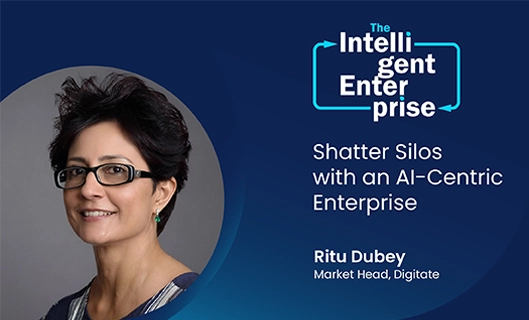
This week, I’m joined by Ritu Dubey, global head of new business sales and market development at Digitate. Ritu has spent more than two decades helping global organizations transform how they work by harnessing technology, from building new markets across Europe and the Americas to driving exponential growth in AI-enabled solutions. She brings real world insights on how enterprises can shift from reactive operations to predictive, resilient and autonomous models that truly scale. Today, we’re going to unpack the risks of keeping AI efforts isolated inside enterprises.
Ritu Dubey:
So when AI sits inside a function like sales, or HR, or finance or IT, it tends to be optimized locally and that further reinforces the existing boundaries.
Tom Stoneman:
And explore why leaders can’t afford to leave intent open to interpretation.
Ritu Dubey:
The leaders who succeed are the ones who spend as much time on clarity and trust as they do on strategy and system. And that’s what allows technology and now AI to transform enterprises, rather than just I would say automate it.
Tom Stoneman:
Let’s get inside the future of enterprises by stepping outside of them. So Ritu, I want to welcome you, and thanks for being on the show.
Ritu Dubey:
Thanks for having me, Tom. It’s a pleasure.
Tom Stoneman:
So first and foremost, we do this with everyone. We want to find out what your break time activity that you go to when you’re deep in a problem.
Ritu Dubey:
Yeah. When I’m stuck in a problem, I realized that I’m too close to the problem. So my typical approach is that I try to shift from completely being inside it to becoming an observer of the problem. So some of the strategies I adopt for my break time activity is that I deliberately go into a quiet place and observe my thoughts and reacting to them. Secondly, I do something very different. I stare at a horizon, like something which is completely open, no obstructions because I believe that problems look different when you zoom out. So these are some of the strategies I adopt during such situations.
Tom Stoneman:
That’s great. Yeah, let’s move into the great part here because you’ve been doing this a long time. And I know one of the things you talk about is making sure that people try to implement AI in a more unified approach. So the question I wanted to ask you is do you think enterprises moving AI to the core of their business strategy can help them to solve this issue?
Ritu Dubey:
Absolutely. I think moving AI to core of business strategy is necessary and it can help strengthen enterprises, but I think it’s not sufficient on its own. And what see today in most enterprises is that AI is being deployed in silos because organizations are organized around functions and functions are siloed. They’re not organized today around outcomes.
So when AI sits inside a function like sales, or HR, or finance or IT, it tends to be optimized locally and that further reinforces the existing boundaries. So putting AI at the core of the conversation, from where to we deploy kind of a conversation, to what outcomes are we trying to drive across the enterprise. And that really unlocks, when AI is designed around end-the-end value streams, order to cash, or pack to ship, or lead to revenue. And that forces a cross-functional approach and unified decision making.
So definitely, enterprises that really break the silos are the ones that make AI central to their strategy, but when they pair it with an operating model change and not just for better technology. One can see that that is what gave rise to the SRE function and modern SREs focus on user journeys, they focus on business outcomes. To also quote some of the examples that I have seen personally myself, one of the CPG companies that we worked with for one of their key processes called direct store delivery that is responsible for putting some of the popular items onto the retail store shelves. They were able to do that an measure the KPIs related to on time delivery, order cycle time, route service representative efficiency, all of that they were able to measure to a business KPI by layering AI technology over it and that’s what is the value to the business, not just technology in itself.
Another example, we working with a pharma company and they have completely centralized their AI platform. And what that allows you to do is they were able to, for example, for one of their demand planning processes which is responsible for collecting data from different siloed organizations, 250 integrations, to make this demand planning process happen. For them, they were able to reduce leveraging AI technology from four weeks to seven days.
So I think in a sense, what I’m trying to say is that it is a great platform, AI is a great technology for us to break the cross-departmental silos. But at the same time, it does require enterprises to implement an operating model change. If I have to draw a panel, what’s happened in the last week or one-and-a-half week ago where the whole market was shifting around the SaaS companies and one of the reasons the companies that are really making headways are the ones, the SaaS companies are the ones which are able to work with multiple SaaS products, they’re able to work with multiple kinds of data. So that kind of ability to break down the silos not within one enterprise, but how even SaaS companies are transforming by making their own value creation through operations with multiple other technologies and platforms and tools. That is creating a very attractive space for even SaaS companies to be in. So it’s happening across the board for all kinds of organizations. So definitely, that’s something that will help them transcend the siloed barriers that they have today.
Tom Stoneman:
I love the way you look at it. I think it’s definitely the wave of the future. Let’s take that same question and turn it on its side a little bit. There’s a recent interview that you did with William Visterin, the editor-in-chief for Computable.be. And you mentioned that unlocking the transformative potential and achieving the scale effect of AI and automation does require adoption of integrated strategies, a shift from all kinds of different islands, like islands of automation, islands of insights, islands of observability and to take more of a unified approach, which is what you were just talking about.
So now, let’s look in the future. I want to ask you, in three to five years, how do you see, how will a business that adopted a unified approach or a transformative approach differ from ones that took the siloed approach?
Ritu Dubey:
Definitely I believe that in three to five years, and that’s even shrinking even more, the differences are going to be unmistakable. A bit that takes a very transformative approach to AI will operate in a connected ecosystem, if I can call it. Their decisions are going to be faster, they’ll be more consistent. They’ll be much more proactive, intelligent and the accountability will flow across functions. And if you look like outcomes like customer experience, revenue, operations, risk, all of this will be optimized end-to-end. Then AI won’t feel like a tool, but that’s the way how business things end run. And if you contrast that with companies that adopt AI in silos, they will have some efficiency, some pockets of automation, but definitely they are going to struggle with frictions and slower decision making. And they may be efficient locally, as I can say, but not meaningfully competitive.
So ultimately, I think the gap is going to become very strategic and one organization that’s going to continually be learning and adapting and changing, and the other still trying to manage manually the complexity that they have.
Tom Stoneman:
Ritu is describing two very different futures. In one, AI becomes part of the fabric of the enterprise. Accountability is shared and over time, organizations start to think and respond as a connected system, rather than a collection of departments. In the other future, AI remains contained, the underlying model of the business doesn’t really change. Complexity is still managed manually and decisions still slow down as they move across silos.
The strategic value of what Ritu is pointing to is key, this isn’t just about automation or productivity, it’s about whether enterprises can build a continuous learning advantage. And if enterprises are going to learn faster, their leaders need to learn faster. That means finding ways to think clearly, even when the signals are messy and the stakes are high. Now, as we always do, we’re going to get inside Ritu’s world and learn how she makes space to help her work through the complexities of AI implementation.
Ritu Dubey:
So one of the things which I typically do is, let’s say I’m sitting in a place where there are people around, conversations are happening, I’m deep in my problem. Even though I’m in a state of flow and I’m stuck, I’ll just walk away. I’ll stand up, walk away from my desk, go to a quiet place. That quiet place could be just a conference room where just I’m there alone. If I’m at my home, it would be a room where I’m completely alone by myself. So that’s, for me, just easily just walking away without my computer, just thinking through what’s going on, how my mind and brain is processing the problem. So that’s something very simple I do.
I also sometimes go to an area where there’s no obstruction. So in our offices, we have these cabins where just completely unobstructed, you can see the horizon, you can see the sky. And for me, that is going into that kind of a space also helps me clear, and helps me think better and helps me make better decisions. So those are some of the simple things that I do.
Tom Stoneman:
I just did an episode with our CEO Akhilesh Tripathi and we were talking about ping pong. And he finds that to relax him just because it has that rhythmic sound back-and-forth. Of course, you see where I sit in the office, I’m right next to the ping pong table and it’s the opposite for me. So I used to sneak up to the, we have an open floor above us on the 12th floor, I’d sneak up there and you could just get away from everything until they caught me and I ruined it for everybody and now no one can go up there.
Ritu Dubey:
Yeah. I think for me, I need to create a space for myself with just me and my thoughts.
Tom Stoneman:
So what happens if that doesn’t work? Is there a backup or another activity?
Ritu Dubey:
I’ve seen that when I sometimes organize a space, it helps me organize my thoughts. So I’ve seen myself do that as well sometimes around the house, and organizing let’s say a room and that clarifies my thoughts as well. It shifts that clarity into the problem that I’m solving.
Tom Stoneman:
Let’s move over to, it’s still on the same lines, but let’s see if we can compartmentalize a little bit about what we were talking about before. I want to ask you, what do you see as fundamental pillars for developing a successful AI strategy within enterprises?
Ritu Dubey:
That’s a great question. I think about a successful AI strategy, I think about four fundamental pillars. The first is, from an organization standpoint, you need to have clear business intent. I talk about outcomes and I believe that AI initiatives, they have to be anchored in business outcomes. Outcomes could be related to growth, efficiency, improvement in customer experience, resilience, or a combination of all of the above. Without that clarity, I think it becomes more an experiment, a side project without everyone going on to create full impact.
The second I believe is important is data foundation. And by data foundation, I don’t mean centralization of data. What I mean is the ability to connect and create context out of it. So enterprises need to have the ability to access, understand and reason across data that lives through multiple functions and multiple systems because AI needs context and context comes from connected data.
The third is an operating model built for scale or autonomous scale. And this includes governance, the cross-functional ownership like SREs driving reliability and outcomes, and infusing agent-led execution with the ability to act on insights in real-time, so the whole autonomous scaling.
And finally, it’s about people and culture. So how do you build mindsets and skills, and how do you build skills and be willing to change how work gets done today? So how do you bring that kind of a change management, how do you execute change management to change mindsets and give people the skills that are necessary to navigate the change that is required in the new AI world? So all of this results in AI becoming a very strategic capability and that will compound over time substantially.
Tom Stoneman:
All right. So I want to switch gears completely here now and just ask some more introspective kind of questions. One question that we ask everyone is what’s one thing you’ve learned either about technology, people or in general that you think more enterprise leaders should understand?
Ritu Dubey:
I think most enterprise challenges I would say are technology problems, but I would say more alignment problems. So a real impact in anything comes when people, decisions and incentives are all aligned around a shared outcome. So technology only amplifies whatever alignment, misalignment already exists. So I would say the leaders who succeed are the ones who spend as much time on clarity and trust as they do on strategy and system. And that allows technology and now AI to transform enterprises, rather than just I would say automate it. Because technology scales intent and leaders need to be clear about the intent they are scaling.
My own personal leadership philosophy, if I have to reflect on it, I say it’s the three Cs. It’s about clarity, consistency and conviction. And for me, clarity stands at the top. What is your intent behind what you’re trying to do?
Tom Stoneman:
Is there any part of your life where you would prefer that there’s more of a human touch over AI? I guess what I’m saying is is there a part of your life that you think should be kept AI-free?
Ritu Dubey:
I think for me personally, I would say definitely relationships and moments of reflection. I think that, for me, remains, should remain deeply human. Conversations with family, even when you’re mentoring people, moments of silence. I don’t think I want those moments to be mediated by AI for sure. I think AI is definitely incredible at scale, at pattern recognition, at speed, but I think meaning comes from presence and shared experiences. So I’ll keep it intentional where it belongs.
Tom Stoneman:
And along those same lines, can you imagine something that AI will be able to do that’s never been done before?
Ritu Dubey:
Yeah, I can think of a few areas that AI would definitely do more. I think one is of course, I think we all know the ability to reason through massive, massive complexity and data, and we talk about AI telling us the unknown unknowns. It’s basically even revealing what we didn’t know to ask, so I think that’s one of the fundamental things.
The second thing I would say is also allowing us to simulate the future, the future scenarios. Not simulate the future, but the future scenarios. Test certain strategic directions, if a market is going to change a certain way or if a policy is changing, what does that mean in the digital world before it starts acting in the real world. So I think those are the kind of things that definitely AI will be able to do.
And interestingly, I was hearing someone today and one of the comments they were making is they were talking about their organization where the ability to understand all of the data, conversations about people that are happening, in example in a given company, and have a super employee which can at least answer you the questions like, “What’s the pulse of an organization? Really, how is the organization thinking at this moment?” How do you get a sense of all of that? And I think that’s one of the examples which would be humanly impossible to do and I think AI is able to do that. So yeah.
Tom Stoneman:
Yeah. One of the funny things that I think about is it’s moving so fast and there’s so many things happening right now that even five years ago, we would have been just amazed and now, just commonplace. ChatGPT, all that stuff, it’s just there. Well, almost like how did we live without it? Just like how did we live without cellphones?
What I keep coming back to is this idea that the real challenge isn’t about technology, the real work is getting the organization aligned around it. Ritu makes the point that AI doesn’t magically transform an organization. Instead, it amplifies whatever is already there. If decisions, incentives and culture are aligned around a shared outcome, AI compounds that advantage over time. It becomes a capability that gets stronger with every cycle of learning. But if the organization is fragmented, AI simply scales that fragmentation. That’s where change management comes in because building a successful, intelligent enterprise is, first and foremost, about clarifying intent, unifying that intent and building the trust required for everyone to move together. In the end, AI maybe the catalyst, but alignment is the multiplier.
Thank you for listening to The Intelligent Enterprise, a podcast where we get inside big ideas by getting outside of them. I’ve been your host Tom Stoneman. Please remember to follow the podcast and leave a comment or review wherever you get your shows. See you next time.

Digitate’s empowers organizations to transform their operations with intelligence, insights, and actions.
Redefining IT operations with AI and automation
Enabling predictable, Agile and Silent batch operations in a closed-loop solution
End-to-end automation for incidents and service requests in SAP
Autonomously detect, triage and remediate endpoint issues
AI-based analytics to improve Procure-to-Pay effectiveness
Transform software testing and speed up software release cycles
Digitate helps enterprises improve the resilience and agility of their IT and business operations with our SaaS–based platform.
ignio™, Digitate’s SaaS-based platform for autonomous operations, combines observability and AIOps capabilities to solve operational challenges
Autonomous IT Solutions for the Modern Industry
ignio’s AI agents, with their ability to perceive, reason, act, and learn deliver measurable business value and transform IT operations.
Discover how we empower customer success and explore our latest eBooks, white papers, blogs, and more.
Discover what top industry analysts have to say about Digitate
Get insights from the Forrester Total Economic Impact™ study on Digitate ignio
Explore our upcoming and recorded webinars & events
Discover the capabilities of ignio™’s AI solutions
Explore insights on intelligent automation from Digitate experts
Digitate policies on security, privacy, and licensing
Digitate ignio™ eBooks provide insights into intelligent automation
Explore our upcoming and recorded podcast
Learn how businesses overcame key AI-driven automation issues
Guides cover AIOps and SAP automation examples, use cases, criteria
A library of in-depth insights and actionable strategies
At Digitate, we’re committed to helping enterprise companies, realize autonomous operations.
We’re committed to helping enterprise companies realize autonomous operations
Explore the latest news and information about Digitate
Grow your business with our Elevate Partner program
Evolve your skills and get certified
Get in touch or request a demo
Digitate’s empowers organizations to transform their operations with intelligence, insights, and actions.
Redefining IT operations with AI and automation
Enabling predictable, Agile and Silent batch operations in a closed-loop solution
End-to-end automation for incidents and service requests in SAP
Autonomously detect, triage and remediate endpoint issues
AI-based analytics to improve Procure-to-Pay effectiveness
Transform software testing and speed up software release cycles
Digitate helps enterprises improve the resilience and agility of their IT and business operations with our SaaS–based platform.
ignio™, Digitate’s SaaS-based platform for autonomous operations, combines observability and AIOps capabilities to solve operational challenges
Autonomous IT Solutions for the Modern Industry
ignio’s AI agents, with their ability to perceive, reason, act, and learn deliver measurable business value and transform IT operations.
Discover what the top industry analysts have to say about Digitate
Explore Insights on Intelligent Automation from Digitate experts
Get Insights from the Forrester Total Economic Impact™ study on Digitate ignio
Learn how Digitate ignio helped transform the Walgreens Boots Alliance
Digitate ignio™ eBooks Provide Insights into Intelligent Automation
Discover the Capabilities of ignio™’s AI Solutions
Guides cover AIOps and SAP automation examples, use cases, and selection criteria
Discover ignio White papers and Point of view library
Explore our upcoming and recorded webinars & events
At Digitate, we’re committed to helping enterprise companies, realize autonomous operations.
We’re committed to helping enterprise companies realize autonomous operations
Explore the latest news and information about Digitate
Grow your business with our Elevate Partner program
Evolve your skills and get certified
Get in touch or request a demo

Digitate’s empowers organizations to transform their operations with intelligence, insights, and actions.
Redefining IT operations with AI and automation
Enabling predictable, Agile and Silent batch operations in a closed-loop solution
End-to-end automation for incidents and service requests in SAP
Autonomously detect, triage and remediate endpoint issues
AI-based analytics to improve Procure-to-Pay effectiveness
Transform software testing and speed up software release cycles
Digitate helps enterprises improve the resilience and agility of their IT and business operations with our SaaS–based platform.
ignio™, Digitate’s SaaS-based platform for autonomous operations, combines observability and AIOps capabilities to solve operational challenges
Autonomous IT Solutions for the Modern Industry
ignio’s AI agents, with their ability to perceive, reason, act, and learn deliver measurable business value and transform IT operations.
Discover what the top industry analysts have to say about Digitate
Explore Insights on Intelligent Automation from Digitate experts
Get Insights from the Forrester Total Economic Impact™ study on Digitate ignio
Learn how Digitate ignio helped transform the Walgreens Boots Alliance
Digitate ignio™ eBooks Provide Insights into Intelligent Automation
Discover the Capabilities of ignio™’s AI Solutions
Guides cover AIOps and SAP automation examples, use cases, and selection criteria
Discover ignio White papers and Point of view library
Explore our upcoming and recorded webinars & events
At Digitate, we’re committed to helping enterprise companies, realize autonomous operations.
We’re committed to helping enterprise companies realize autonomous operations
Explore the latest news and information about Digitate
Grow your business with our Elevate Partner program
Evolve your skills and get certified
Get in touch or request a demo