


Tom Stoneman:
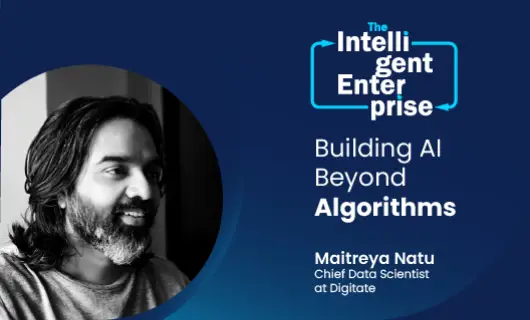
Hi, I’m Tom Stoneman, and this is The Intelligent Enterprise where every two weeks we take a break from the chaos of enterprise life, and get inside a big idea by getting outside of it. Each episode we meet an industry expert who helps cut through the noise from all the updates and rollouts while exploring one of their favorite break time activities. It might be over coffee, a walk, or even a game of ping pong, something that gives them some headspace when they’re deep in a problem. Today I’m joined by chief data scientist at Digitate Dr. Maitreya Natu. Maitreya has spent his whole career at the crossroads of theory and practicality, working out how to bridge the gap between algorithms and the human experience.
Maitreya Natu:
They’re happy with AI solutions augmenting their daily life, but blindly trusting what an AI solution is recommending to carry out a business-critical activity is a challenge that we face time in, time out.
Tom Stoneman:
Maitreya has a PhD in computer and information Sciences, over 50 published papers, and more than 20 patents to his name. But what really stands out is how he takes big abstract ideas and turns them into real solutions that run, scale, and adapt inside large organizations. Today, we talk about the difference between building something that works versus something that people trust, and how Maitreya uses running as a tool to clear his head. So let’s get inside the future of enterprises by stepping outside of them.
Maitreya, if you had to describe your role at Digitate in one sentence, what would that be?
Maitreya Natu:
I would say my job is to make enterprises intelligent. So it involves developing algorithms, dealing with data, understanding business problems, and finding creative ways in which AI can be used to solve real world problems.
Tom Stoneman:
You’re the perfect guest for this podcast, The Intelligent Enterprise. I’m just curious what inspired you to get into technology?
Maitreya Natu:
Well, complex systems have always excited me. Whether it is a complex human system like traffic or a railroad network or something, or a complex system of sensors, or complex system of computers, data centers, humans and so on and so forth. Even social networks is a complex system in some way. So the sheer complexity of these systems, I find them very exciting. And then the art of taking one complex problem, systematically breaking down into smaller pieces, and finding either existing solutions to solve them or finding new ways to solve these complex pieces to collectively solve a bigger problem is something very exciting. And thankfully, I got a chance to do a formal education in AI, which gave me all the levers required to do these things. That was an natural progression into the world of AI, if you will.
Tom Stoneman:
Got it. That’s fantastic. So in your role, I know you see a lot from theory to practicality. So for you, what’s been the one biggest tension to overcome?
Maitreya Natu:
There have been many. Whenever a problem comes to me, let’s say something as simple as forecasting future behavior of an application, or a business workload, or sales and so on, you believe that there are lots of algorithms that are already out there that can be used to solve this problem. But when it comes to translating these theory into practice, many real world constraints, preferences and characteristics come into play. At times data is noisy, at times you don’t have enough data points, at times there is tacit knowledge that comes into solve a particular problem which is not solvable by the out of box libraries, and so on and so forth. So converting theory into practice has always been a big challenge because you think the problem is already solved, but when a real world problem comes you realize that the already existing solutions are not enough to solve them, and you have to either change them or build something from the scratch and so on.
But even harder tension has been adoption of AI by business. When you provide an AI driven insight, making businesses accept it with a sense of belief and act on it, especially when it is something business-critical, is a challenge. Because businesses drive with a lot of tacit knowledge, a lot of intuition, a lot of experience that they have built over the years. And when an AI engine is deriving an insight or a recommendation, they need to know how an AI engine has reached that insight. Why it is recommending what it is recommending? And a lot of AI solutions today are inherently black box. They do not provide an explanation of why they’re recommending what they’re recommending, and that becomes a challenge. Because of that, businesses do not adopt AI solutions very quickly for something very, very business-critical. They’re happy with AI solutions augmenting their day in a life, but blindly trusting what an AI solution is recommending to carry out a business-critical activity is a challenge that we face time in, time out.
Tom Stoneman:
Do you feel that there’s a fear of disruption when you’re talking to-
Maitreya Natu:
Well, yes and no. Of course there is that sense of insecurity, but at the same time I understand their lack of faith. Any engine, if it is recommending something without giving any explanation, it’s hard to trust that engine. You want to know at least some chain of thought behind why that AI system is doing what it is doing. And that’s where we had to build a lot of solutions around it to make that happen. So I won’t say it’s just the fear of disruption, it’s a very genuine need for explanation as well.
Tom Stoneman:
What I’m hearing here is that the real tension isn’t about the technology, algorithms or workflows, but about belief. Convincing people to trust AI, especially when it’s handling high-stakes operations, is no small task. When the engine behind a decision feels like a black box, it’s natural to hesitate, and that hesitation can slow down transformation. For AI to drive real impact, people have to see how it works and why it works before they’re willing to let go of the wheel. And that’s where Maitreya and its team come in. Building AI that not only performs, but earns trust.
Is there any one particular instance where that tension was really bubbled up to the surface?
Maitreya Natu:
Oh yeah, many. So since last two years, we have been working on a feature called Ticketless Enterprises. So typically the IT operations in an enterprise revolve around tickets. What are tickets? So whenever there is a problem in an application or in a disk or a server or a network, a ticket gets created, which is like an incident. Somebody is reporting an incident that, “Hey, this application, this machine, this server is not working as expected.” And then either the support teams or operation teams or command center teams act on those tickets to resolve them. Now of course, part of this process is human, part of this is automated, and all those things are there, but more or less IT operations are revolving around tickets. We were questioning this whole approach of ticket-driven operations because there are two problems. One, it is inherently reactive. You’re waiting for bad things to happen and then you’re going to act on fixing them, right? And second is the focus is always on meeting the timelines of that ticket resolution. The focus shifts from stability of a system or experience of an end user to meeting the deadlines of resolution of a ticket. So because of that, we are questioning that do we really have to revolve around tickets to manage enterprise IT operations, or can we go towards a more ticketless operation?
And when we were doing that, we kind of fundamentally questioned today’s approach of managing IT operations, and we offered four principles. First principle was that eliminate or automate. Why bother invest on automating these incidents when you can eliminate them. Look at recurring issues, find their causes, and try to eliminate these incidents in the first place so that they don’t just come. The second principle is okay, you can’t eliminate everything, but if you can’t eliminate them can you at least predict and prevent them instead of reacting to them? So if I know that every Monday morning, whenever the backup starts, my application slows down, and I know there is a pattern here. First of all, I will try to eliminate it by finding why this backup is leading to this slowness of application. But if I cannot, at least can I give a heads-up that, “Hey, it’s Monday morning and your applications might be slow, and let’s do something to prevent that from happening.” Now of course, you can’t eliminate everything. You can’t predict and prevent everything.
For those that you cannot eliminate or prevent, can you at least discover yourself before somebody else has to tell you? Why should an end user tell me that, “Hey, my application has slowed down”, or why should an alert come to me that, “Hey, the disk is full.” Can I self-discover and then act on it? So it might not be eliminating, it might not be predictive, but it’ll at least be fastly reacting. So I sense before somebody else has to tell me. And lastly, if you cannot eliminate, if you cannot predict, if you cannot discover and somebody reports it to you, then instead of somebody calling up a call center and reporting their problem or logging in a ticket, can we create a self-assist engine where they can just converse with a solution to get their problem resolved, instead of going through this ticket route?
Tom Stoneman:
This is really important. A ticketing system in an IT operation has traditionally been the backbone to most enterprise IT systems. So to completely rethink the challenge from tickets to ticketless isn’t just a technical upgrade, it’s a shift in the mindset. Instead of building a system that assumes there’s going to be failure, can we build a system that expects reliability? That’s not just automating how we handle issues, but is eliminating them altogether? And if that’s not possible, can we at least see them coming? It’s a subtle change, but an impactful one, and really rewrites the rule book of IT operations. It’s going to change how we detect issues, how we communicate them, and ultimately how we can trust the process.
Maitreya Natu:
A lot of AI adoption challenges came because when we are saying, “Hey, 30% of your incidents can be eliminated”, we had to convince them that why we are saying what we are saying. Or if we are saying that “20% of your incidents can be predicted four hours ahead of time”, you need to give enough evidence behind all these insights and recommendations. So it had both. The fear of disruption because you are questioning the traditional way of reporting thousands of tickets and having armies of people solving them. And at the same time, you’re generating insights about their operations which they’re doing day in, day out. So this was one experience where we sensed a lot of tension, and we had to find many creative solutions to ease people through it.
Tom Stoneman:
That’s pretty interesting. Did agentic AI have any play in there?
Maitreya Natu:
Lots. So this is my take on it. When you’re working on business-critical solutions, people need determinism and people need explainability, and these are business users who are going to adopt our solution. We still use the data mining and machine learning, which is the traditional AI that we have been using over the years. While it works, it ensures determinism, it gives transparency, it provides explainability and all. It inherently relies on the assumption that there is sufficiently good quality data that is present in the system on which these models can be trained, and then predictions can be made, or root diagnosis can be done, and so on and so forth. If you do not have good quality data, or if you’re working on a problem that needs tacit knowledge or knowledge that humans have captured over years of intuition and experience, then traditional logical reasoning falls short.
And that is where generative AI and large language models become very useful. Because for any exception, for any unknown situation, when my data is insufficient I can bring human agentic interfaces where I can say that, “Hey, I have come across a situation.” Let’s say I’m trying to diagnose an incident. I have looked into the models, I looked into the data, I couldn’t find a cause. I use LLMs to understand the domain, the technology, whatever knowledge LLM can provide me to further take my diagnosis. Even if that is not enough, then I can use human agentic interfaces where I can converse with a domain expert to understand how to solve this particular situation, learn from those interactions, and over time increase my knowledge base so that next time a similar situation arises I’m able to solve this, even if I have less data and so on and so forth. So this is where we had to move from logical reasoning to generative reasoning, if you will, and build solutions that combine both. One provides transparency, explainability, determinism, while another provides creativity, and it can deal with incomplete, inconsistent data.
Tom Stoneman:
What stands out here is that progress in enterprise AI doesn’t necessarily come from throwing out the old and starting again, but comes from blending with the new. Traditional AI systems offer structure. They’re designed to be deterministic and grounded in clean data, but that’s not often the case in the real world. This is where agentic AI and large language models come in. They help fill the gaps by drawing on broader knowledge and surfacing connections you otherwise wouldn’t see. It’s a shift from logical reasoning to something more adaptive, and it’s this kind of collaboration that’s driving real innovation in how enterprises make smarter decisions.
So I want to ask you, what’s the one thing you’ve learned, either about the technology, the people, or both, that you think more enterprises or more enterprise leaders should understand?
Maitreya Natu:
There’s something that I found very important over the years, that am I solving the right problem? And am I solving it the right way? Answers to both these questions are very important when you’re trying to solve a real world problem, if you will. So whenever I come across a problem, I ask five questions. Is the problem important? Is the problem difficult? How is the world addressing this problem? How is my solution different from what the world is doing? And what will be my contribution to the largest space of technology and science if I solve this problem? If I answers to all these five, then I feel confident that yes, I’m getting into the right problem.
Once I have answer to that, then comes the second question: am I solving it the right way? And that’s very hard, and that’s a continuously evolving journey. While doing that, my biggest lessons have been the theory into practice lessons. That always try to respect the real world constraints, real world preferences, real world limitations while building that solution. Otherwise, it might happen that you’re building something that works for one instance, two instance, three instance, but you’re not able to scale it up to 10, 100, thousands if you’ll. So that has been my mantra along. Am I solving the right problem, and am I solving it right? If I answers to both, then I’m happy.
Tom Stoneman:
And here’s where Maitreya’s love of running comes in. That full body experience that gets him out of his head, something that’s rooted in the physicality of the real world and helps keep solutions front and center when deep in a challenge.
Maitreya Natu:
What I like most about the process of running is that, at some point in time, you reach a state of I like to call it thoughtlessness. So you stop thinking about anything. And after that, it almost does a mind reset of sorts. And then whatever problem you are stressed about, you’re able to find new ways of looking at it.
Tom Stoneman:
So I’m going to you a bonus question. Is there anything that you think AI can do that hasn’t been done before?
Maitreya Natu:
So I would answer it slightly differently. AI has always been pushing the boundaries of creativity all along, but now with generative AI and AI agents coming into play, the penetration of AI is a lot more deeper in the society, if you will. And the way I look at it is we are going to enter a realm of augmented intelligence. Every human’s intelligence is going to get augmented with AI. If you’re a doctor, you’ll be a more intelligent doctor. If you’re a painter, you’ll be a more creative painter. If you’re a teacher, you’ll be more effective teacher. If you’re a data scientist, you’ll be a lot more creative data scientist. That’s where I see AI headed. That it’s eventually going to be a game of augmented intelligence, in anything and everything that you do. It’s not about replacing humans. It’s going to be a very powerful, very creative world that we are entering into, because every human being is going to get augmented with AI. And because of generative AI and agentic, that penetration is going to be a lot deeper now. The way internet and then cell phones had a very deep penetration into society, now it’s AI’s time. It would reach every new corner of every country, every city, and that’s what we will see. So that’s how I see AI headed, and this has never happened before. This deeper penetration of AI has never happened before.
Tom Stoneman:
So I’m not much of a runner, but I’ve taken a leaf out of Maitreya’s book after our conversation and gone for a walk to let it all sink in. What stuck with me is this: it’s not just about building the smartest systems, it’s about making sure they solve the right problems in the right way. And that means asking better questions, challenging assumptions, and designing with the real world in mind. It also means meeting people where they are. You can have the most powerful AI in the world, but if no one trusts it, it won’t move the needle. Maitreya reminded me that there is a duality to everything, theory and practice, and that’s maybe the biggest takeaway. If you want to build something that truly works, you can’t do it in isolation. You need the data, yes, but you also need the dialogue. And if you’re stuck, get out. Maybe for a run, or even a walk. It’s also a good excuse to get some steps in. Thank you for listening to this episode of The Intelligent Enterprise, a podcast where we get inside the big ideas by getting outside of them. I’ve been your host, Tom Stoneman. Make sure you’re following the podcast, and leave a comment or review wherever you get your shows.

Digitate Named a Leader in AIOps — Worldwide
Discover why IDC recognized Digitate as a Leader in AIOps. Get the full analyst report and see how ignio™ delivers unified observability & autonomous operations.
Download Report →

Digitate’s empowers organizations to transform their operations with intelligence, insights, and actions.
Redefining IT operations with AI and automation
Enabling predictable, Agile and Silent batch operations in a closed-loop solution
End-to-end automation for incidents and service requests in SAP
Autonomously detect, triage and remediate endpoint issues
AI-based analytics to improve Procure-to-Pay effectiveness
Transform software testing and speed up software release cycles
Digitate helps enterprises improve the resilience and agility of their IT and business operations with our SaaS–based platform.
ignio™, Digitate’s SaaS-based platform for autonomous operations, combines observability and AIOps capabilities to solve operational challenges
Autonomous IT Solutions for the Modern Industry
ignio’s AI agents, with their ability to perceive, reason, act, and learn deliver measurable business value and transform IT operations.
Discover what the top industry analysts have to say about Digitate
Explore Insights on Intelligent Automation from Digitate experts
Get Insights from the Forrester Total Economic Impact™ study on Digitate ignio
Learn how Digitate ignio helped transform the Walgreens Boots Alliance
Digitate ignio™ eBooks Provide Insights into Intelligent Automation
Discover the Capabilities of ignio™’s AI Solutions
Guides cover AIOps and SAP automation examples, use cases, and selection criteria
Discover ignio White papers and Point of view library
Explore our upcoming and recorded webinars & events
At Digitate, we’re committed to helping enterprise companies, realize autonomous operations.
We’re committed to helping enterprise companies realize autonomous operations
Explore the latest news and information about Digitate
Grow your business with our Elevate Partner program
Evolve your skills and get certified
Get in touch or request a demo

Digitate’s empowers organizations to transform their operations with intelligence, insights, and actions.
Redefining IT operations with AI and automation
Enabling predictable, Agile and Silent batch operations in a closed-loop solution
End-to-end automation for incidents and service requests in SAP
Autonomously detect, triage and remediate endpoint issues
AI-based analytics to improve Procure-to-Pay effectiveness
Transform software testing and speed up software release cycles
Digitate helps enterprises improve the resilience and agility of their IT and business operations with our SaaS–based platform.
ignio™, Digitate’s SaaS-based platform for autonomous operations, combines observability and AIOps capabilities to solve operational challenges
Autonomous IT Solutions for the Modern Industry
ignio’s AI agents, with their ability to perceive, reason, act, and learn deliver measurable business value and transform IT operations.
Discover what the top industry analysts have to say about Digitate
Explore Insights on Intelligent Automation from Digitate experts
Get Insights from the Forrester Total Economic Impact™ study on Digitate ignio
Learn how Digitate ignio helped transform the Walgreens Boots Alliance
Digitate ignio™ eBooks Provide Insights into Intelligent Automation
Discover the Capabilities of ignio™’s AI Solutions
Guides cover AIOps and SAP automation examples, use cases, and selection criteria
Discover ignio White papers and Point of view library
Explore our upcoming and recorded webinars & events
At Digitate, we’re committed to helping enterprise companies, realize autonomous operations.
We’re committed to helping enterprise companies realize autonomous operations
Explore the latest news and information about Digitate
Grow your business with our Elevate Partner program
Evolve your skills and get certified
Get in touch or request a demo